
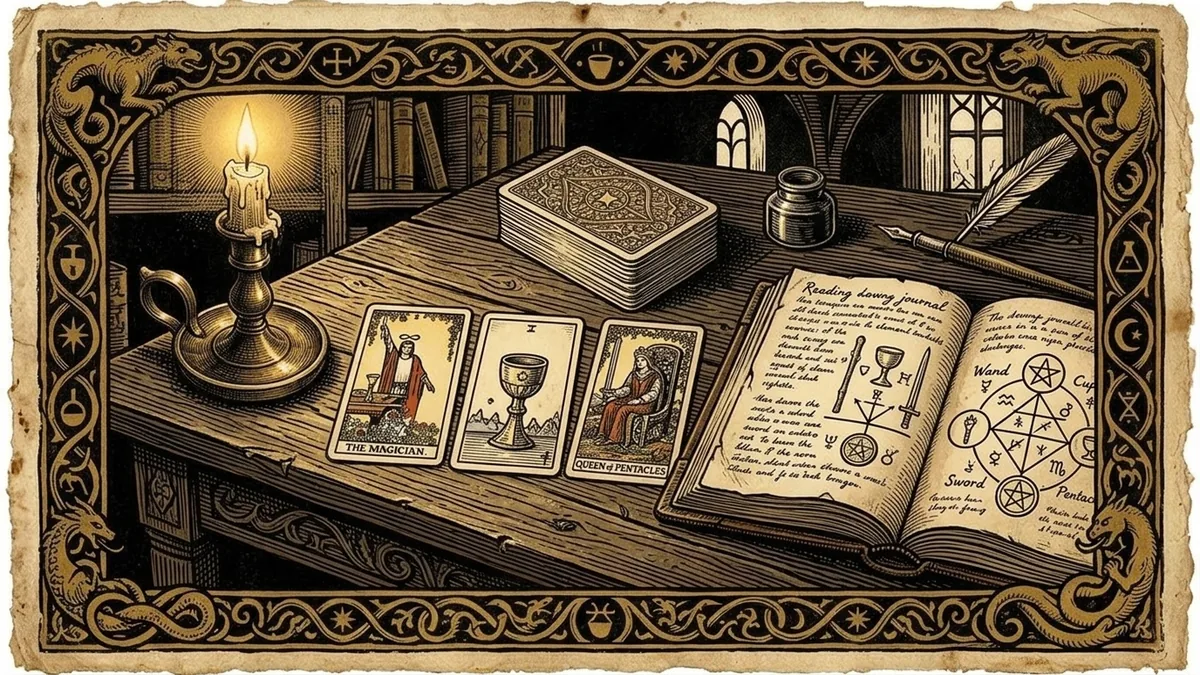
Walk into most bookshops looking to learn tarot and you will leave with two pounds of purple velvet, a head full of invented Egyptian priesthoods, and seventy-eight flashcards you cannot string into a coherent sentence when three cards hit the wood together. Meanwhile, the people who actually read well treat the pack the way a master carpenter treats a level and a square: as an optical instrument built out of four suits, ten numbers, sixteen court postures, and twenty-two major human thresholds.
This guide is built to take you from opening your first tuck-box to reading a live three-card spread without drowning in esoteric fog. We will cover the historical architecture of the seventy-eight-card pack, why you never need to memorize all seventy-eight cards by rote, how to phrase questions that actually produce usable answers, which spreads belong on a beginner's desk, a fully worked three-card reading from question to action step, honest ethical boundaries, deck selection, and a concrete thirty-day learning plan.
1. What Tarot Is - and What It Is Not
At its simplest physical level, a tarot deck is a pack of seventy-eight illustrated pasteboard cards divided into two unequal halves: twenty-two emblematic trump cards known as the Major Arcana, and fifty-six suit cards known as the Minor Arcana. Taken together, those seventy-eight plates form a structured symbolic and visual language for examining human situations, motives, bottlenecks, and choices.
To use the deck soberly, it helps to strip away three centuries of promotional mythology. Tarot did not descend from the sunken temples of Atlantis or the Book of Thoth in ancient Memphis. It began in Northern Italy during the first half of the fifteenth century - in the courts of Milan, Ferrara, and Bologna between roughly 1430 and 1450 - as a trick-taking card game called carte da trionfi ("cards of triumph") and later tarocchi. Noble families commissioned painters like Bonifacio Bembo to add twenty-two allegorical trump cards (depicting Renaissance pageantry: the Pope, the Empress, the Chariot, Time, the Wheel of Fortune, Death, and the Last Judgment) to the standard four-suited pack of Mamluk playing cards that had entered Europe through Islamic Spain and Venice a century earlier.
For more than three hundred years, Europeans primarily played parlor games with those cards. Only in the late eighteenth century did French writers - first Antoine Court de Gebelin in 1781, followed by the Parisian print-seller Jean-Baptiste Alliette, who read cards under the reversed name Etteilla - begin publishing systematic treatises on cartomancy. A century after that, in late-Victorian London, members of the Hermetic Order of the Golden Dawn wove the seventy-eight cards together with astrological decans, elemental dignities, and Pythagorean number structure. In December 1909, writer Arthur Edward Waite and stage illustrator Pamela Colman Smith published the Rider-Waite-Smith deck through William Rider & Son in London. For the first time in wide commercial print, all fifty-six Minor Arcana cards were staged as complete theatrical scenes with human actors, gestures, weather, and props rather than bare geometric suit pips.
Tarot as a Diagnostic Mirror, Not a Fixed Prophecy
Anyone who promises that a piece of printed cardboard can predict next Wednesday's lottery numbers or tell you whether a former lover in another city is currently looking at your photograph is selling theater, not cartomancy. Human futures are not railroad tracks bolted into bedrock; they are weather systems shaped by habit, temperament, contracts, and what you do before Friday afternoon.
What a tarot reading actually provides is a structured external mirror. When you sit inside a complicated problem - a stalling career, a strained marriage, a two-way financial decision - your own brain recycles the same three defensive arguments on a loop. Dealing three or five cards onto a wooden table interrupts that loop. Because every card in the 1909 deck depicts a specific human posture and elemental pressure, forcing yourself to map the painted scene onto your question exposes what you were trying not to look at.
Who Tarot Is For - and What Expectations Are Realistic
- Who gets the most out of Tarot: Readers, writers, decision-makers, and observant beginners who want a disciplined visual tool for self-reflection, structured journaling, and dissecting interpersonal dynamics without mystical dependency.
- What Tarot can reliably do: Clarify hidden friction in a relationship or workplace, compare the emotional and practical costs of two competing options, name the habit that is keeping a situation stuck, and supply concrete behavioral prompts.
- What Tarot cannot do: Replace a physician, a licensed attorney, a structural engineer, or a tax accountant; read the private mind of an absent third party without your own projection; or absolve you of the responsibility of making your own decisions.
2. The Architecture of a Tarot Deck
Open a standard seventy-eight-card box and sort the pile into its two structural halves. As we explain in our dedicated study on Major Arcana vs. Minor Arcana, the two sections operate like the hour hand and the minute hand on a pocket watch.
The Major Arcana: 22 Cards for Structural Thresholds
Numbered in Roman numerals from 0 (The Fool) to XXI (The World), the twenty-two Trumps represent overarching life chapters, developmental turning points, and structural forces that are larger than a single Tuesday afternoon. When a Major Arcana card lands in a spread, it names the climate of the whole chapter: an initiation (The Magician), an unavoidable moral or contractual choice (The Lovers), the end of an outgrown era (Death), the sudden collapse of a false facade (The Tower), or quiet convalescence after a storm (The Star).
Because the twenty-two Majors make up roughly 28 percent of the deck, a three-card spread will statistically contain zero or one Major trump. If you deal five or ten cards and more than half of them are Major Arcana, deep structural forces have taken the wheel; if no Major Arcana cards appear in a reading, the issue is entirely a matter of everyday habits and street-level housekeeping that you can fix with practical action.
The Minor Arcana: 56 Cards for Everyday Life, Decisions, and Moods
The remaining fifty-six cards are divided into four suits of fourteen cards each: Wands (Staves), Cups (Chalices), Swords (Blades), and Pentacles (Coins or Disks). Each suit contains ten numbered pip cards running from Ace (1) to Ten (10), plus four royal Court Cards: the Page, Knight, Queen, and King.
Where the Major Arcana announces the weather front, the Minor Arcana shows who remembered to bring an umbrella, who left the kitchen window open, and who is paying for the roof repairs. In Codex III: Fire, Water, Air, Earth and our guide to the four elements in tarot, each suit governs one classical element and one concrete department of daily life:
| Tarot Suit | Element & Twin | Core Life Domain | Visual & Kinetic Signature | When Overloaded or Missing |
|---|---|---|---|---|
| Suit of Wands Staves / Rods (14 cards) |
Fire Clubs (♣) | Fast, hot, active |
Willpower, ambition, enterprise, creative drive, courage, friction, and raw physical energy. | Living wooden staves sprouting green shoots; deserts, red tunics, salamanders, and figures in mid-stride. | Too many: Burnout, rash temper, picking fights. Missing: Low motivation, waiting for permission. |
| Suit of Cups Chalices / Goblets (14 cards) |
Water Hearts (♥) | Fluid, receptive |
Feelings, affection, intimacy, empathy, grief, nostalgia, intuition, and family or romantic bonds. | Gold chalices holding water; rivers, shorelines, lotus blossoms, blue robes, and offered or spilled vessels. | Too many: Moodiness, wishful daydreaming. Missing: Emotional dryness (no Cups in a reading). |
| Suit of Swords Blades / Spades (14 cards) |
Air Spades (♠) | Sharp, rapid, cold |
Intellect, logic, spoken truth, contracts, conflict, anxiety, boundaries, and surgical decisions. | Double-edged steel broadswords; windblown clouds, birds, grey stone walls, and piercing sightlines. | Too many: 3 a.m. overthinking, verbal cruelty. Missing: Avoiding hard truths or clear terms. |
| Suit of Pentacles Coins / Disks (14 cards) |
Earth Diamonds (♦) | Slow, dense, solid |
Everyday work, money, budgets, craft, property, bodily health, endurance, and tangible results. | Gold disks engraved with a five-pointed star; plowed fields, stone arches, gardens, and workbenches. | Too many: Materialism, stubbornness, rut. Missing: Unpaid bills, castles in the air. |
3. The Most Important Cards Briefly Explained
You do not need to swallow all seventy-eight cards in a single sitting. If you understand eight anchor plates from the Major Arcana, the ten-step number ladder of the Minor Arcana, and the four Court ranks, you already hold the skeleton key to the entire 78-card Tarot directory.
Eight Anchor Cards of the Major Arcana
Look at the actual 1909 Pamela Colman Smith plates below. Notice how each card communicates its meaning through physical staging before you ever read a textbook definition:
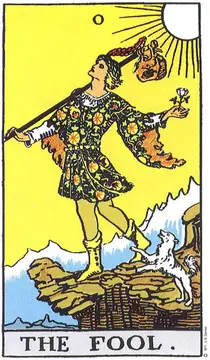
The Fool
Unscripted beginning & leapA traveler steps toward a cliff edge with his chin tilted twenty-eight degrees upward, carrying a light knapsack and a white rose while a small dog barks at his heels. Beginner's mind, uncalculated risk, and stepping off the curb before the map is drawn.
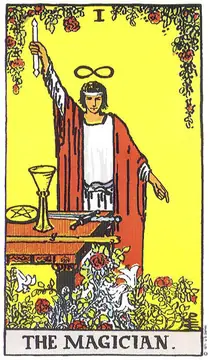
The Magician
Agency, skill & executionOne hand raises a wand to the sky while the other points straight into the earth; on the workbench in front of him sit all four suit tools (Wand, Cup, Sword, Pentacle). Everything required to solve the problem is already on your desk - stop waiting and build it.
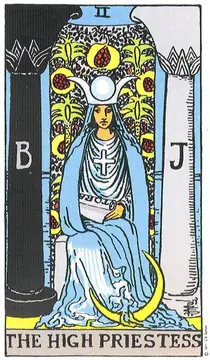
The High Priestess
Silence, reserve & thresholdSeated between black and white pillars (B and J) in front of a pomegranate-patterned veil, holding a scroll half-concealed under her blue mantle. Withholding premature action, listening to what has not been said out loud, and keeping your counsel.
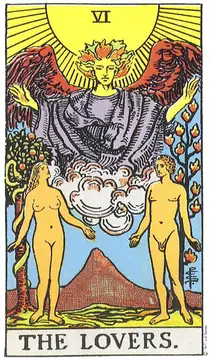
The Lovers
Alignment & binding choiceMore than a valentine: in the 1909 plate, the man looks at the woman while the woman looks up at the angel Raphael. It marks an ethical crossroads where choosing one path or commitment requires renouncing the competing alternatives.
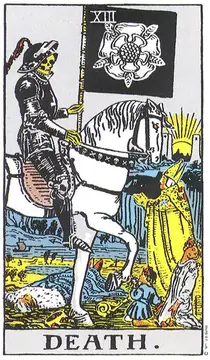
Death
Clean ending & pruningAn armored skeleton rides a white horse carrying a black flag emblazoned with a five-petaled white rose while a sun rises between two towers on the horizon. Almost never physical mortality; it is the irreversible close of an outgrown chapter so new ground can be plowed.
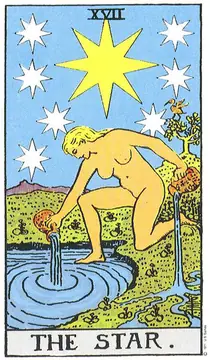
The Star
Unarmored recovery & clarityDirectly after the lightning strike of The Tower, a kneeling figure pours water onto both the dry land and the pool beneath eight shining stars. Quiet convalescence, dropping defensive armor, and regaining a true northern compass.
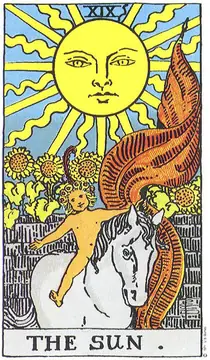
The Sun
Daylight visibility & vitalityA child rides a white horse without saddle or bit in front of a stone garden wall topped with sunflowers under a blazing noon sun. Everything hidden under the Moon is brought into plain daylight; earned confidence, warmth, and unambiguous truth.
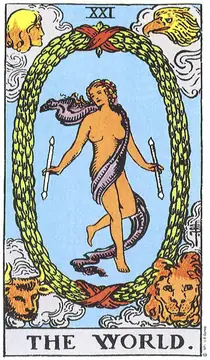
The World
Integration & completed cycleA dancing figure framed inside a tied green laurel wreath, holding two wands while the four fixed creatures (Lion, Bull, Eagle, Angel) guard the corners. The account is settled in full; a long apprenticeship reaches mastery and whole-system closure.
The Minor Arcana: Numbers Ace to 10 and the 16 Court Cards
In the Minor Arcana, the number at the top of the card tells you how far along the situation has traveled and how much structural pressure it is under. As we detail in Codex II: The Tarot Number Code and our study on how numbers shape meaning in tarot, every number from Ace to Ten carries the exact same structural job across all four suits:
| Rank / Number | Structural Stage | How It Behaves Across the Four Suits |
|---|---|---|
| Ace (1) | Raw Root & Seed | A single hand emerging from a cloud offering the pure, unspent element: a new spark (Wands), emotional opening (Cups), sharp realization (Swords), or tangible resource (Pentacles). |
| Two (2) | Polarity & Threshold | One splits into two: weighing two roads (2 of Wands), meeting a partner eye-to-eye (2 of Cups), stalemate behind crossed blades (2 of Swords), or juggling two budgets (2 of Pentacles). |
| Three (3) | First Fruit & Expression | The binary produces its first visible result: ships leaving harbor (3 of Wands), shared celebration (3 of Cups), a painful third-party truth (3 of Swords), or collaborative craftsmanship (3 of Pentacles). |
| Four (4) | Four Walls & Stability | Consolidation inside a four-cornered structure - either a welcome shelter (4 of Wands, 4 of Swords) or a rigid box that refuses to move (4 of Cups boredom, 4 of Pentacles hoarding). |
| Five (5) | Friction & Stress Test | An odd fifth point shatters the cozy square of the Four. Every Five introduces conflict or loss: turf scrimmage (5 of Wands), spilled goblets (5 of Cups), bitter victory (5 of Swords), or financial pinch (5 of Pentacles). |
| Six (6) | Reciprocity & Repair | Re-establishing equilibrium after the crisis of the Five: public recognition (6 of Wands), warm memory (6 of Cups), ferrying away from trouble (6 of Swords), or settling accounts (6 of Pentacles). |
| Seven (7) | Audit, Doubt & Strategy | Stepping back to question the comfortable symmetry of the Six: defending high ground (7 of Wands), facing seven competing illusions (7 of Cups), lone-wolf stealth (7 of Swords), or auditing a slow harvest (7 of Pentacles). |
| Eight (8) | Kinetic Force & Discipline | Concentrated work or movement: airborne velocity (8 of Wands), walking away from an empty shoreline (8 of Cups), mental self-imprisonment (8 of Swords), or steady bench mastery (8 of Pentacles). |
| Nine (9) | Ripeness & Solitary Peak | The element reaches maximum solo intensity: battle-worn vigilance (9 of Wands), private satisfaction (9 of Cups), 3 a.m. insomnia (9 of Swords), or earned financial autonomy (9 of Pentacles). |
| Ten (10) | Saturation & Inheritance | The container is completely full and tips into a new cycle: carrying ten heavy logs alone (10 of Wands), family fulfillment (10 of Cups), total exhaustion of an argument (10 of Swords), or multi-generational estate (10 of Pentacles). |
| Court Cards Page, Knight, Queen, King |
Human Actors & Ranks | Pages stand on the ground holding the suit tool like students or couriers; Knights sit in the saddle charging or stalling at the speed of their horse; Queens govern the element from the inside with poise; Kings enforce it outwardly as executives and magistrates (see how Court Cards really work). |
Why You Never Have to Memorize All 78 Cards
Beginners stall because they treat the deck like seventy-eight unrelated vocabulary words in a dead language. Once you know four suits and ten numbers, fifty-six cards snap into a simple grid: Suit (what department of life) + Number (what stage of pressure) + Picture (what the actor is physically doing). When the Five of Pentacles hits the table, you do not need to recall a paragraph from a booklet: Pentacles is money and bodily shelter, Five is a structural disruption, and the picture shows two people walking past a lit window in the snow. Memory follows visual structure automatically.
4. Learning Tarot: Day One at the Table
Forget candles, moon water, and silk cloths. What a beginning reader actually needs is a desk lamp that does not glare off the card varnish, twenty quiet minutes before checking email, a standard 1909 Rider-Waite-Smith deck, and a cheap lined notebook.
- Clear the surface and shuffle: Sit at a clean table, shuffle the pack three or four times until your hands relax, and cut the deck once.
- Pull a single Daily Card: Draw one card from the top and lay it face up in front of you (you can also compare your physical pull against our online Daily Tarot Card workbench).
- Write your raw observation before touching any book: Keep your guidebook closed for sixty seconds. If you look up the official keywords first, your eyes stop working and your brain simply nods along with the author.
Mini-Exercise: Three Visual Questions to Ask Any Single Card
In Codex I: Tarot by Sight (which goes out free as a Reader's Edition PDF to newsletter subscribers), we train beginners to interrogate any card with three literal questions before uttering an abstract psychological word:
- Question 1 - Posture & Hands: What is the figure physically doing with their spine, hands, and feet? Are they gripping a coin to their chest, offering a goblet at arm's length, slouching on a bench, or standing in iron greaves? (See body language in tarot and what hands mean in tarot cards.)
- Question 2 - Sightline: Where are the painted eyeballs pointing - and what is behind their back? A figure facing left is looking back into the past or the previous card; a figure facing right is pushing into the next step; a figure staring straight out of the frame is addressing you directly.
- Question 3 - Weather & Architecture: What is the room, the ground, and the sky doing? Is the sky bright yellow, flat grey, or pitch black? Is there a stone wall, a locked gate, or an open road behind them?
Write three plain sentences answering those three questions in your notebook, then close the notebook and go to work. Check the entry at nine o'clock that evening to see where that exact posture showed up during your day.
5. How to Ask the Right Question
Ninety percent of muddled tarot readings fail before the deck is even shuffled. A ten-card spread cannot rescue a terrible question, whereas a single card can cut straight to the bone of a sharp one.
Why Weak Questions Fail
Three habits ruin beginner questions:
- Passive fortune-telling ("Will he come back?", "Will I get the apartment?"): These questions hand all agency to an invisible fate and treat you like a spectator waiting at a bus stop. Worse, when asked about an ex-partner, they invite you to spy on a third party's hypothetical thoughts rather than examining what you actually control.
- Delegating moral responsibility ("Should I quit my job?", "Should I break up with her?"): Pasteboard cards do not pay your rent or live with your loneliness. Asking the deck to make an executive decision for you is a way of looking for someone else to blame if the choice goes sideways.
- Loaded self-accusation ("Why do I always ruin my relationships?"): A question built on an insult forces every card that lands to act as a prosecutor.
Bad Questions vs. Strong Diagnostic Questions
A productive tarot question is open-ended (starts with What, How, or Where), situationally specific, and centered on your own agency and blind spots:
| Weak / Fatalistic Question | Why It Stalls the Reading | Strong, Action-Oriented Question |
|---|---|---|
| "Will my ex text me back this month?" | Binary prediction about someone else's phone; fuels anxious re-dealing. | "What is the actual state of trust between us right now, and what helps me handle this silence cleanly?" |
| "Should I quit my job?" | Outsourcing a major livelihood decision to a shuffle of paper. | "What is the hidden cost of staying at this desk for another year versus the real challenge of leaving now?" |
| "Will my new business succeed?" | Treats business success as weather rather than execution. | "Which blind spot in my current launch plan am I overlooking, and where should I put my main effort this quarter?" |
| "Why is my life so stuck?" | Too vague and self-pitying; no concrete department of life named. | "What habit of mine is keeping this situation stalled, and what is the smallest concrete lever I can pull this week?" |
Four Ready-to-Use Question Templates
Whenever you sit down to read, plug your topic into one of these four structural frames:
- The Blind-Spot Audit: "What aspect of [specific situation] am I currently refusing to look at clearly?"
- The Lever Question: "What is the most constructive action I can take regarding [specific problem] over the next two weeks?"
- The Two-Road Comparison: "What do I walk into if I choose [Option A], what do I walk into if I choose [Option B], and what criterion settles the choice?"
- The Friction Diagnosis: "What is driving the tension between me and [person/project], and what is my honest share of the responsibility?"
6. How to Lay a Tarot Spread: Step-by-Step Guide
Whether you are reading for yourself at a kitchen table or across the felt for a friend, follow the same six-step sequence every time so your method never drifts into guesswork:
- Settle and write down the question: Write the question at the top of your notebook page before your hands touch the cards. If you change the question mid-deal to flatter the cards that show up, you are cheating yourself at solitaire.
- Choose the spread and lock the positional contract: Decide in advance how many cards you are pulling and what each slot on the wood means (for instance: Card 1 = What brought us here; Card 2 = Where the friction sits today; Card 3 = What happens if nothing changes). A card laid without a pre-agreed positional contract is just a picture floating in space.
- Shuffle calmly and draw: Shuffle until your breathing slows down, cut the pack on the wood, and deal the cards into their assigned slots.
- Turn the cards and scan the whole table first: Before you zoom in on Position 1, spend ten seconds scanning the whole layout from three feet back:
- How many Major Arcana versus Minor Arcana cards landed?
- Which suit or element dominates the table, and which suits are completely missing?
- Where are the figures looking (gaze direction), and are any two adjacent cards facing each other or turning their backs?
- Read each card inside its position, then build one sentence: Read Card 1 strictly as an answer to Position 1's label, Card 2 through Position 2, and Card 3 through Position 3. Then lock all three cards together into one complete grammatical sentence using conjunctions like because, while, or unless.
- Record the draw and one concrete check: Write down the date, the question, the cards drawn, your one-sentence synthesis, and one small practical step you will test within seventy-two hours.
7. The Best Tarot Spreads for Beginners (Plus Decision Tree)
Beginners almost always reach for the largest layout they can find because ten cards look more impressive on a tablecloth than three. That is like learning to drive in an eighteen-wheel articulated lorry. Use the decision tree below to match the spread size to the actual weight of your question:
| Your Situation / Question Type | Recommended Spread | Cards | Why This Layout Fits & Live Tool |
|---|---|---|---|
| Morning reflection or daily visual drill | The Daily Card | 1 Card | Trains visual observation without combinatorial noise. Try the Daily Card Workbench. |
| Simple, concrete tactical check ("Is the timing ripe today?") | Single-Card Yes / No | 1 Card | Cuts minor hesitation with a clear Yes, No, or Not Yet verdict. Try Yes / No Tarot. |
| Understanding how a situation developed and where it is heading | Past - Present - Future | 3 Cards | The gold-standard beginner spread: clear beginning, middle, and trajectory (3-Card Spread Guide). |
| Choosing between two concrete paths or offers | Decision Spread | 3 or 5 Cards | Puts Option A and Option B side-by-side on the table (Two Paths Decision Spread). |
| Checking romantic, family, or business partnership dynamics | Relationship Spread / Bridge | 3, 6, or 7 Cards | Separates your posture from the other person's and the bridge between you (7-Card Love & Relationship Reader). |
| Major life crossroads with hidden history, inner resistance, and outside pressure | The Celtic Cross | 10 Cards | Full diagnostic audit across a 6-card Cross and 4-card Staff (Interactive 10-Card Celtic Cross Reader). |
1. The Daily Card (1 Card): One Lens for the Day
Pull one card in the morning not to ask "What will happen to me today?", which turns you into an anxious tourist waiting for an accident, but "Where should I keep my eyes open today?" A single card takes two minutes to record and builds a personal archive of how cards behave in real life.
2. The Three-Card Spread: Past, Present, Possible Development
There is a good reason why every serious teacher starts students on the Three-Card Past-Present-Future layout. Three cards are the smallest number required to build a narrative line with cause, friction, and consequence, yet small enough that you can see every sightline and suit collision at a single glance. Always read Position 3 as "Possible Development / Trajectory if current habits continue" rather than unalterable fate.
3. The Decision Spread: Option A, Option B, What You Need to Know
When you are torn between two concrete moves, deal three cards in a horizontal row: Position 1 = What happens if I commit to Option A; Position 2 = What happens if I commit to Option B; Position 3 = The decisive factor I need to weigh first. Look closely at which option draws the heavier elemental friction and which card Position 3 faces.
4. The Relationship Spread: Your Needs, The Shared Dynamic, Possible Next Step
For an honest three-card check on any partnership, assign Position 1 = Your posture and unspoken need; Position 2 = The shared dynamic or bottleneck on the bridge between you; Position 3 = Constructive next step. When a relationship question is more entangled - such as an ex-partner during no contact, a new romantic spark, or a long-standing standoff - step up to our interactive 7-Card Love & Relationship Bridge, which maps Your Mind, Heart, and Mask (positions P1-P3) directly across from your Counterpart's (positions P4-P6) around a central Bridge keystone (P7).
5. The Celtic Cross (10 Cards): When It Makes Sense - and Why It Doesn't Have to Be Your Starting Point
Published by A. E. Waite in The Pictorial Key to the Tarot (1910), the Celtic Cross splits ten cards into two structural halves: a six-card Circle/Cross on the left (1. The Core Situation; 2. The Crossing Obstacle/Catalyst; 3. Conscious Crown; 4. Unconscious Root/Foundation; 5. Receding Past; 6. Approaching Near Future) and a four-card Vertical Staff on the right (7. Your Posture; 8. External Environment/House; 9. Hopes & Fears; 10. Culminating Outcome). It is a magnificent diagnostic machine when a major life chapter has half a dozen moving parts, and you can test its full sightline geometry on our 10-card Celtic Cross workbench. Just do not force it onto a Tuesday-morning question that three cards could settle in ninety seconds.
8. Example: Interpreting a Three-Card Spread from Start to Finish
Most beginner guides describe the positions of a three-card spread and stop right before the hard part: showing how three real cards collide to answer a real human question. Let us walk through a complete table reading step by step.
The Starting Question
The Querent's Situation: Elena, a thirty-four-year-old senior graphic designer, has been offered the role of Creative Operations Director at her agency. The promotion comes with a 20 percent salary bump, but it pulls her off hands-on design work to referee two feuding project teams after the previous director quit from exhaustion. Instead of asking the passive binary question "Should I take the promotion?", she writes down:
"What foundation brings me to this offer (Position 1), what is the real nature of the role waiting for me right now (Position 2), and where does this trajectory lead over the next six months if I accept it on the current terms (Position 3)?"
The Three Drawn Cards on the Cloth
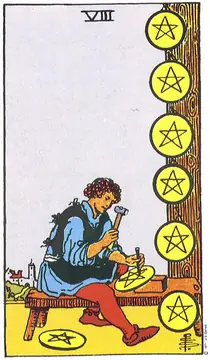 Eight of Pentacles
Earth | Rank 8 | Gaze: Left & Down at Bench (◄)
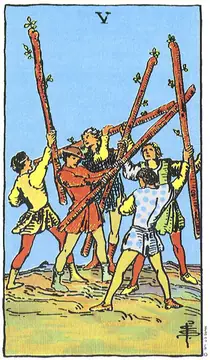 Five of Wands
Fire | Rank 5 | Gaze: Tangled Inward Clash (►◄)
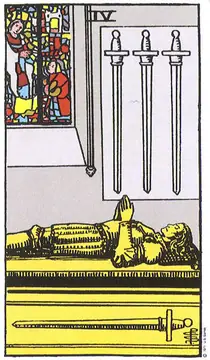 Four of Swords
Air | Rank 4 | Gaze: Eyes Closed, Horizontal Rest (●)
Step 1: Altitude & Elemental Scan Before Reading a Single Word
- Major vs. Minor Ratio: Zero Major Arcana cards, three Minor Arcana pip cards. That is immediate good news: this is not a karmic earthquake. It is an everyday workplace structure problem entirely within Elena's power to negotiate or decline.
- Elemental Weather & Missing Suit: We have Earth (Pentacles), Fire (Wands), and Air (Swords) - and zero Water (no Cups) on the table. Nobody in this story is acting out of personal affection or emotional loyalty; it is a dry transaction of output, turf, and nervous fatigue.
- Number Progression (8 to 5 to 4): Notice that the numbers run backward from high productive output (8), down into acute mid-cycle disruption (5), and finally into a forced four-cornered halt (4).
Step 2: Meaning of Each Card in Its Position
- Position 1 (Foundation) - Eight of Pentacles: Look at the young stonemason seated alone on his wooden bench outside the town gates, quietly hammering one identical pentacle after another and hanging them neatly on a vertical post. Elena earned this offer because she is a disciplined, reliable craftswoman who keeps her head down and delivers immaculate solo work. Notice, however, that the craftsman is sitting completely alone with his back turned to Position 2.
- Position 2 (Present Friction) - Five of Wands: Five youths in mismatched tunics brandish five long wooden staves in an open field, crossing sticks in every direction without a referee or a shared target. The role she is being asked to step into is not creative leadership; it is an unrefereed political scrimmage where five loud egos are fighting over turf and nobody has clear line authority.
- Position 3 (Possible Development) - Four of Swords: Inside a quiet stone chapel, a knight lies stretched flat on his back atop a stone tomb with his hands folded in prayer; three swords hang point-down over his chest and head while a fourth sword is carved into the stone base beneath him. If Elena walks out of her quiet solo workshop (Eight of Pentacles) straight into that five-way office brawl (Five of Wands) on the current terms, she will end up horizontally exhausted within six months - either taking medical leave, shutting her office door in defensive isolation, or putting her own creative career into cold storage just to survive the noise.
Step 3: The Interplay & One-Sentence Synthesis
Look at how the postures across the three frames collide: a solitary seated craftswoman (8 of Pentacles) is thrown into a standing five-man stick fight (5 of Wands), and ends up lying flat on her back (4 of Swords). Put the whole reading into a single grammatical sentence:
"Because you built your reputation through quiet, solitary craftsmanship at the workbench (Eight of Pentacles), stepping into an unrefereed departmental turf war without clear authority (Five of Wands) will drain your nervous system until you are forced onto the sidelines to recover (Four of Swords)."
Step 4: Concrete Action Impulses
- Do not sign the offer as a vague 'peacemaker': The Five of Wands shows five sticks of equal height with no King or Queen in the room. If Elena considers the job at all, she must demand written decision-making authority and a clear reporting hierarchy before accepting.
- Protect your workbench time: The Eight of Pentacles shows that her actual satisfaction comes from tangible craft. If the new role strips away 100 percent of her maker hours in exchange for refereeing meetings, the 20 percent raise will go straight toward paying for burnout recovery.
- Take the Four of Swords deliberately now instead of involuntarily later: Ask for four quiet days (Four of Swords) to audit the department's actual turnover and workload numbers before giving her answer.
Step 5: What This Reading Does NOT Prove
Notice what this spread does not claim. It does not prove that her bosses are malicious conspirators, nor does it predict that she will fall physically ill in November if she signs the paper. It simply holds up an unmistakable structural mirror: moving a solitary master craftswoman (8 of Pentacles) into a chaotic management brawl (5 of Wands) without structural boundaries produces nervous shutdown (4 of Swords).
9. How to Read Cards Without Memorizing Keywords
When a card lands on the wood and your mind goes completely blank, do not reach for your phone to look up a keyword list. Walk your eyes through five concrete layers on the pasteboard:
- Layer 1 - The Human Action & Spine: Who is in the frame, and what verb describes their body? Standing, kneeling, sprinting, slouching, hiding, or lying down?
- Layer 2 - Color & Atmospheric Weather: In the 1909 Rider-Waite-Smith plates, Pamela Colman Smith used flat theatrical lighting. A bright canary-yellow sky (The Sun, Magician, Strength, Six of Wands) signals open visibility and conscious warmth; a slate-grey sky (Three of Swords, Five of Swords, Eight of Swords) signals mental overcast, stalemates, and cold wind; a pitch-black background (The Devil, The Tower, Nine of Swords, Five of Pentacles) signals claustrophobia, panic at night, or feeling locked in a cellar.
- Layer 3 - Architectural Props & Boundaries: Check the furniture. As we document in walls, gates, and doors in tarot and crowns and thrones in tarot symbolism, stone walls divide insiders from outsiders, blindfolds mark self-imposed refusal to see, and armor marks emotional distance.
- Layer 4 - Suit + Number: Combine the elemental department (Fire/Wands, Water/Cups, Air/Swords, Earth/Pentacles) with the numerical stage (Ace = spark, 4 = box, 5 = friction, 8 = work/velocity, 10 = full load).
- Layer 5 - The Positional Contract: Filter everything above strictly through the label of the slot where the card landed.
Why the Question Context Always Overrides Dictionary Keywords
Textbook keyword lists fail because a symbol changes its job depending on the room it walks into (see tarot symbols explained). Take the Three of Swords - three steel blades piercing a red heart under grey rainclouds:
- In a romantic breakup reading: It reads as a sharp, painful betrayal or an unspoken grief that needs to be cried out in the open.
- In a business partnership audit: There is no romance on the table; it reads as a three-way contractual split or a blunt audit that cuts away sentimental excuses.
- In a writer's editing spread: It means taking a red pen and ruthlessly cutting three darling paragraphs that are clogging the chapter.
Same card, same three blades, three completely different real-world nouns because the question supplies the noun while the card supplies the modifier.
The Card Journal as Your Primary Learning Engine
Keep a simple three-column notebook on your desk: Column 1 = Date, Question & Cards Drawn; Column 2 = What I Physically Saw on the Card & My One-Sentence Reading; Column 3 = What Actually Happened 7 Days Later. Thirty entries in that third column will teach you more about cartomancy than twenty paperbacks.
10. Reversed Cards: Useful Nuance or Unnecessary Confusion?
Sooner or later while shuffling, you will accidentally turn part of the pack 180 degrees around and deal a card upside down. Beginners usually react in one of two ways: either they secretly twist the card right-side up hoping nobody noticed, or they consult a cheap booklet that claims an upside-down card means the exact opposite of its upright meaning.
What Upright vs. Reversed Actually Means
Reading a reversed card as its lazy opposite is bad logic. If the deck wanted to tell you "misery and grief," it would not hand you The Sun upside down; it already has the Ten of Swords, the Three of Swords, and the Five of Cups in the box for that job. As we detail in Codex X: The Reversal Key and our essay on how reversed cards change meaning, turning a card upside down never changes the subject on the card - it changes the pressure and plumbing through six specific modes:
- 1. Delayed or Ripening Slowly: The Sun reversed is still daylight and success, but cloud cover is delaying the harvest by a few weeks.
- 2. Internalized or Private: The action is happening inside the querent's private thoughts rather than out on the public street.
- 3. Blocked or Stalled: The gear is jammed against a neighboring obstacle card.
- 4. Covert or Behind Closed Doors: A court card or action operating off the public record.
- 5. Overdriven / Excess: A Knight of Wands reversed isn't timid; he is driving the horse into a ditch from sheer impatience.
- 6. Loosening or Releasing (on heavy obstacle cards): When the Ten of Swords or Four of Pentacles turns upside down, gravity pulls the pinned swords out of the back or shakes the hoarded coins loose from the miser's fist.
Why Beginners Should Read Exclusively Upright First
For your first thirty to sixty days at the table, keep all seventy-eight cards upright. Every single human nuance - delay, conflict, secrecy, excess, and release - is already represented inside the seventy-eight upright scenes whenever two or three cards sit side by side. Turning reversals on before you can read upright sightlines and suit weather simply doubles your hesitation at the table. Once you can read any upright three-card draw in a single clear sentence, you can introduce reversals as a pressure gauge.
11. Five Common Beginner Mistakes - and the Ethical Limits of Tarot
Even observant readers fall into predictable traps during their first year, especially when reading for their own anxieties. Watch out for these five habits:
- Dealing too many cards at once: Pulling a ten-card Celtic Cross and four "clarifier" cards on top of every slot because you did not like Card 3 turns your table into card soup. If you do not understand a card in a three-card spread, stop dealing more pasteboard and look closer at the two neighbors already flanking it.
- Forcing binary Yes/No questions onto complex dilemmas: A single-card Yes/No draw is great for checking whether a straightforward tactical move has wind in its sails, but asking a yes/no oracle "Should I marry Thomas?" strips away every clause that matters.
- Taking card titles and grim illustrations literally: Beginning querents still flinch when XIII Death, XVI The Tower, XV The Devil, or the Ten of Swords hits the felt. In a mundane Tuesday spread, Death is cleaning out a dead project or ending a bad lease; The Tower is a sudden reality check that pops an inflated ego; the Ten of Swords is dramatic exhaustion at the end of a long argument.
- Reading each card in isolation: Treating Position 1, Position 2, and Position 3 as three separate fortune cookies instead of reading the card combination as a single subject-verb-object sentence.
- Projection and compulsive re-dealing ("Deck Shopping"): Shuffling and dealing the same question four times in one evening until the Two of Cups or The Sun finally turns up. The first deal answered your question; the second, third, and fourth deals only measure your refusal to hear it.
Hard Ethical & Professional Boundaries
As we emphasize in how professional tarot readers think and in our standalone book Across the Table, a serious reader knows where the edge of the table ends. Tarot is never a substitute for licensed professional counsel:
- Medical & Psychological Health: Never use cards to diagnose symptoms, alter medication, or replace a physician or psychotherapist.
- Legal & Contractual Liability: Never use a spread in place of a qualified attorney when signing contracts, handling custody, or navigating litigation.
- Financial & Investment Decisions: Never gamble savings, pension funds, or tax compliance on cartomancy.
- Third-Party Snooping: Refuse to play private detective on people who are not sitting in the room and have not consented to be read.
12. Which Tarot Deck Fits You Best?
All seventy-eight-card tarot decks descend from three historical design families. Choosing the right lineage on day one will save you months of frustration.
| Deck Lineage | Minor Arcana Style | Strengths & Character | Beginner Suitability |
|---|---|---|---|
| Rider-Waite-Smith (RWS, 1909) Pamela Colman Smith & A. E. Waite |
Fully Illustrated Scenes Every pip from Ace to 10 shows actors, weather, and props |
Unmatched visual clarity, theatrical body language, gaze vectors, and architectural detail; universal reference standard. | #1 Choice for Beginners. Start here so your eyes can read the story immediately. |
| Tarot de Marseille 17th/18th-c. French/Italian woodcuts (Conver, Noblet, Dodal) |
Non-Scenic Geometric Pips Symmetrical arrangements of batons, chalices, swords, and coins |
Historically authentic woodcut line art; rewards pure numerological and geometric reading (like reading playing cards). | Intermediate. Harder on day one unless you already know number + suit syntax. |
| Crowley-Harris Thoth Tarot Aleister Crowley & Lady Frieda Harris (1938-1943) |
Symbolic & Astrological Abstraction Dynamic elemental & decan geometry with printed titles |
Rich Golden Dawn kabbalistic, astrological, and alchemical layering; extraordinary painted color movement. | Advanced. Dense esoteric prerequisites and printed keywords can distract new eyes. |
Four Practical Criteria Before You Buy
- Insist on fully staged Minor Arcana scenes: Avoid minimalist designer decks that print seven gold twigs on black cardstock until you already know the system backward. On our Recommended Tarot Decks page, our top working pick is the Smith-Waite Tarot Deck Borderless Edition (available via Amazon; affiliate link) or the unretouched Classic 1909 Tarot Deck (Amazon; affiliate link).
- Check line clarity and lighting: You want crisp pen-and-ink outlines where you can see which way a figure's eyes and boots point under an ordinary reading lamp.
- Cardstock size and borders: Standard tarot size (2.75 by 4.75 inches / 70 by 120 mm) fits most hands comfortably; borderless editions allow adjacent cards in a spread to touch horizons directly across the cloth.
- Ignore the "Little White Book": Never buy a deck for the tiny fold-out pamphlet tucked inside the box. Buy the deck for the honesty of its drawings, and learn to read the ink with your own eyes.
13. The 30-Day Plan to Learn Tarot
Instead of binge-reading for six hours on a Sunday and abandoning the deck in a drawer by Wednesday, spend fifteen minutes a day for thirty days following this four-week progression:
| Week & Days | Weekly Focus | Daily 15-Minute Table Drill | End-of-Week Milestone |
|---|---|---|---|
| Week 1 Days 1-7 |
Daily Card & Visual Observation | Pull 1 card each morning. Answer the 3 visual questions (Posture/Hands, Gaze Direction, Weather/Props) in your journal before looking up any meaning. | 7 logged daily draws; habit of looking at the ink before reaching for a book. |
| Week 2 Days 8-14 |
Meeting the 22 Major Arcana | Separate the 22 Trumps. Lay them out in three horizontal rows of seven cards (I-VII, VIII-XIV, XV-XXI) with 0 The Fool above. Study 3-4 Trumps per day by comparing their clothing, altitude, and sightlines. | Immediate visual recognition of all 22 Major Arcana thresholds without flashcards. |
| Week 3 Days 15-21 |
Suits, Numbers & First 3-Card Sentences | Days 15-18: Line up all four Aces, all four Fours, all four Fives, and all four Tens side-by-side to see how Fire, Water, Air, and Earth handle the same number. Days 19-21: Deal one 3-card Past/Present/Future draw per day and write a single grammatical sentence. | Ability to decode any Minor card via Suit + Number + Scene and link 3 cards into 1 sentence. |
| Week 4 Days 22-30 |
Thematic Spreads & Sightline Review | Practice specific 3-card contracts: a Decision Spread (Day 23), a Relationship Spread (Day 25), and a Blind-Spot Audit (Day 27), checking missing suits and gaze collisions each time. On Day 30, audit your entire month's notebook. | Confident, independent 3-card table readings with documented real-world feedback. |
14. Frequently Asked Questions About Tarot
Can you teach yourself Tarot - and do you have to be gifted your first deck?
Yes, you can absolutely teach yourself Tarot, and the old rumor that your first deck must be given to you as a gift is pure parlor gatekeeping. Buy your own 1909 Rider-Waite-Smith deck, put a notebook beside it, and treat it like learning to read musical notation or architectural plans.
Do you need to be psychic or clairvoyant to read Tarot cards?
No. Tarot is an optical and symbolic grammar, not a supernatural bloodline. A reader who pays close attention to the question, the positional contract, the elemental balance, and where the figures on the cards are looking will outperform a self-proclaimed psychic every day of the week.
Are Tarot cards dangerous or connected to dark forces?
No. Physically, a tarot deck is seventy-eight pieces of printed cardstock derived from a fifteenth-century Italian court game. Historically, it has no connection to demonic pacts. The only real risk at a tarot table is psychological: using cards to fuel anxious rumination, spy on ex-partners, or avoid making grown-up decisions.
How often should you lay Tarot cards?
A single Daily Card each morning is an excellent five-minute observation drill. For deeper three-card or multi-card spreads on a specific problem, read once and wait until the situation on the ground has actually moved (usually at least one to four weeks) before asking about the same topic again. Re-dealing the same question three times in an hour only measures impatience.
Can Tarot predict the future?
Tarot does not predict fixed, unavoidable fate. What a spread shows is the current momentum of a situation: if you keep driving at your present speed in your present lane without touching the steering wheel, here is the ditch or the harbor directly ahead of you. Change your behavior after reading the spread, and the trajectory changes with it.
What should I do when a card looks "bad" or frightening, like Death or The Tower?
Do not panic and do not sweep the cards back into the box. Look at the question you actually asked and check the neighboring cards. In ordinary life, Death (XIII) signals a clean, necessary ending to an outgrown obligation; The Tower (XVI) breaks down a false assumption that was already structurally unsound; and the Ten of Swords marks the bottom of an exhausting argument so you can finally stand up and leave the room.