
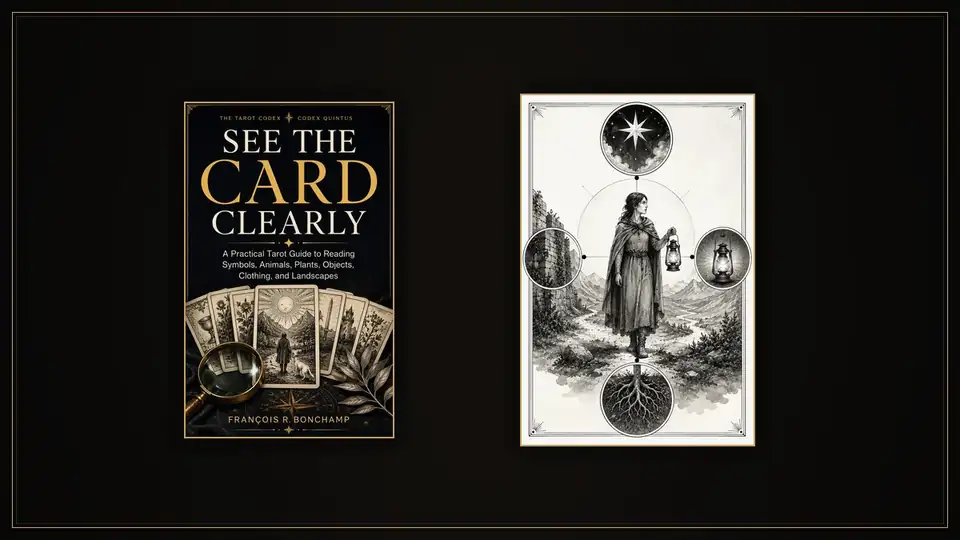
Open any cheap paperback dream dictionary or beginner's tarot manual and you will meet the same dreary habit: treating painted emblems like telegraph code words. A dog always equals "fidelity." A pomegranate always equals "fertility." A mountain peak always equals "an obstacle." Reading cards with a cipher book turns Pamela Colman Smith's seventy-eight stage designs into a dull Victorian parlor rebus, and the first time a dog shows up in a spread about a nasty lawsuit, the cipher falls flat on its face.
In Codex V of The Tarot Codex, See the Card Clearly, we ditch the decoder ring. A tarot symbol is a pressurized visual field whose actual meaning depends on where the thing sits in the frame and what condition it is in when the figure reaches for it.
Six Families of Stage Props
To keep the hundreds of painted objects across the seventy-eight cards from turning into visual soup, sort them into six broad theatrical departments.
The Ground Under the Boots
Always look at the dirt before you look at the crown. Distant mountains, like the purple peaks behind the Eight of Cups or the jagged white crags under the Fool's heels, mark cold high-altitude territory where human domesticity thins out; if those peaks are brick-red, as in the Lovers, the climb burns with bodily heat, whereas snow-capped teeth demand dry ascetic nerve. Flowing water cuts across the dirt to show emotional current and elapsed time: compare the broad tidal river carrying the barge in Death with the sluggish ditch in the Moon. And when you see neatly plowed furrows, as in the Knight of Pentacles or the Ten of Wands, you are looking at slow agricultural debt, soil that has been turned by an ox and expects you to show up with a hoe every Tuesday morning.
Masonry and Doorframes
Whenever human beings stack stones on top of each other in the Rider-Waite-Smith deck, they are trying to keep nature or the neighbors out. Castles and turrets stand for inherited money and municipal law, or for hardened ego shells; when lightning blows the brass crown off the masonry in the XVI Tower, it is because the architect built the walls too narrow for life to breathe inside. Twin pillars, whether they flank the High Priestess's veil (stamped with Boaz and Jachin stolen straight out of Waite's Masonic lodge books) or the Hierophant's throne, form a customs checkpoint between two states of consciousness. Low garden walls, like the brick enclosure behind the naked child in the Sun, merely keep the pigs out of the cabbages, though the high battlements of the Nine of Pentacles lock the whole chaotic world outside the vineyard.
Beasts and Weeds
Plants and animals carry the biological drives that polite people try to hide under their coats. Pamela Colman Smith loved pairing the red Tudor rose of blood desire with the white lily of cold abstract thought; they twine together on the Magician's trellis and sprout at the feet of the Hierophant's kneeling clerks. Canine figures split along domestic lines: the little white terrier yapping at the Fool's ankles is a parlor pet trying to warn its master about a cliff, while the dog and the wolf howling together at the Moon are two halves of the same hungry throat, one wearing a collar and the other still living in the woods. As for the red lion in Strength, notice how the woman does not stab it like Saint George; she tickles its chin until the beast licks her wrist, which tells you everything you need to know about managing a bad temper.
Cloth and Iron
What a figure wears on their back tells you how much they trust the room. Full plate armor, which we dissect at length in our piece on armor in tarot cards, means the body has been sealed inside a tin can to survive a fight, leaving zero skin available for affection. Heavy gold crowns, especially the square one clamped over the miser's cap in the Four of Pentacles, usually weigh more than the jurisdiction is worth. Even the dye vats matter: vermilion robes shout about blood and outward appetite while blue cloaks pull the focus inward toward cold cisterns of memory, and stark white linen claims an innocence that has not yet been tested in the mud.
The Weather Overhead
The upper third of the card sets the metaphysical lighting. A blazing noon Sun with twenty-one waving rays strips away every alibi on the table; a crescent Moon with sixteen human profile teeth drips twilight paranoia and biological tide-pull over the marsh; the eight-pointed yellow Stars promise a compass bearing after the roof has caved in.
Tools in the Fist
Finally, inspect the hardware in the fingers. A wooden staff held high acts as a lightning rod for personal will; a pair of brass butcher's scales weighs meat and guilt by the ounce; the two crossed keys at the Hierophant's slippers claim the right to bolt or unbolt the front door of the church.
Three Rules for Reading a Prop in the Wild
Before you announce what a symbol means across the table, run it through three quick mechanical checks.
Check its physical placement first. A key gripped tight in a fist means the person owns the lock; a key lying in the weeds three feet behind their heel means they dropped their own authority last week; a key hung on a ribbon around the throat is a family obligation they cannot swallow. Second, check the condition of the merchandise, because a fresh rosebud on a bush and a dried brown wreath nailed to a tomb door do not mean the same thing, any more than a flat millpond means the same thing as the pitching green rollers drowning the ship in the Three of Wands. Then watch for spread echoes: if four separate cards in a ten-card layout all feature stone archways, the client is obsessed with thresholds and permissions, while the suits barely matter compared to the masonry.