
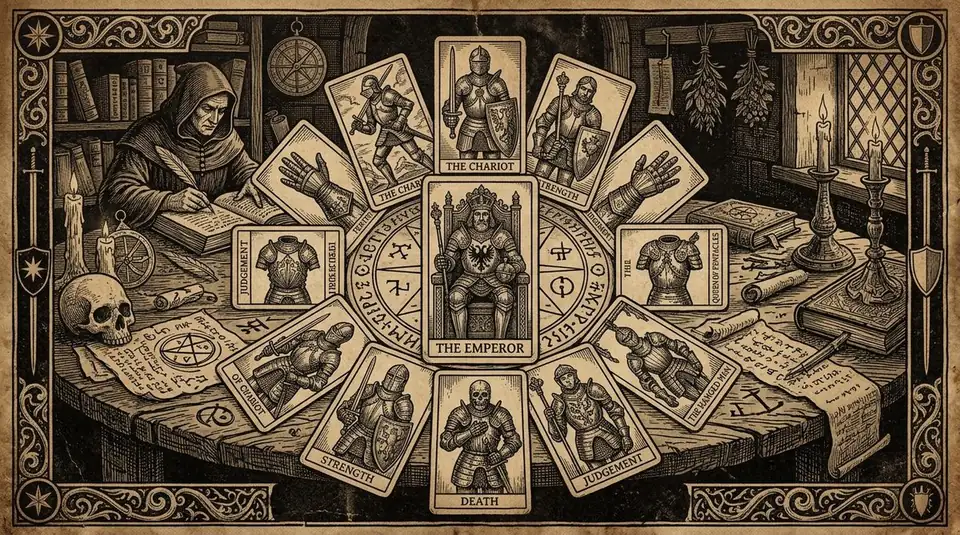
Nobody puts on sixty pounds of articulated Milanese plate mail to go buy groceries, unless they expect the greengrocer to stab them with a halberd. When you see armor in tarot cards, you are looking at a character who has decided that the air outside their ribs is lethal. In The Tarot Codex, steel is a diagnostic of boundary paranoia and institutional weight.
Just as we saw with leather boots in our study of feet and shoes in tarot, metal plating trades sensation for survival. A shoe insulates the sole from sharp gravel; a cuirass and gorget lock the lungs and throat inside a tin can. Reading armor tarot symbolism means asking a very simple question about what armor means in tarot: is the client wearing steel because arrows are actually flying, or have they rusted shut inside a suit they buckled on ten years ago?
What Steel Does to a Body
In fifteenth-century Lombardy, when the Visconti-Sforza decks were being painted in gold leaf, a full rig of plate armor cost roughly as much as a small farm. Analyzing tarot clothing symbolism armor starts with that physical weight. First, steel shields the soft organs: the breastplate guards the sternum while the helm cages the skull, announcing that the wearer expects an ambush. Second, nobody wakes up accidentally wearing greaves and pauldrons; buckling into plate requires a squire and twenty minutes of deliberate preparation before the fight even starts. Third, armor erases the private citizen in favor of an official rank, turning a nervous young man into an anonymous iron projectile. And fourth, metal kills touch. You cannot hug someone in a breastplate without bruising their collarbone.
Call it carapace-logic.
Who Wears the Iron
The Four Knights
In the Minor Arcana, the Knights monopolize the armory. As we lay out in Codex IV, each Knight wears his steel with a completely different relationship to his own skin. The Knight of Swords is a cannonball with feathers on his helmet, charging into the headwind with his visor up and his blade horizontal, every inch of his limbs encased in grey plate so nothing soft can slow his argument down. The Knight of Pentacles sits on a stationary draft horse in dark steel, built to outlast a three-winter siege even if he forgets how to dismount. The Knight of Wands throws a yellow tunic covered in fire-salamanders over his mail so he can twist in the saddle without cooking in his own juice. And the Knight of Cups wears bright, mirror-polished plate while trotting gently along a riverbank holding an open goblet in his bare hand (check our piece on what hands mean in tarot cards for what that ungauntleted palm is doing) - a romantic poet who buckled on a tin suit because his feelings bruise if you look at them sideways.
The Throne and the War-Car
Look at The Emperor (IV). Most beginners only see the red robe and the white beard, missing the steel vambraces on his forearms and the iron greaves sticking out at the bottom of his skirt. He is sitting on a granite block in his own living room wearing full field armor underneath his dressing gown. That tells you how he keeps his kingdom together: by never unbuckling his belt for a single afternoon.
Then look at The Charioteer (VII) standing in his stone box with moon-masks on his shoulders (the Urim and Thummim of occult lore, which Waite lifted from Eliphas Levi). He holds no reins; his armored torso is the rigid pin that keeps the black and white sphinxes from tearing the axle in half.
The Black Plate of Death (XIII)
And then there is Death. The skeleton rides his white mare in midnight-black plate from gorget to sabaton, visor raised only to show that there is no flesh left inside the helmet to negotiate with. You cannot bribe black iron, and you cannot flatter a skull. The armor here is the sheer mechanical indifference of a natural law.
Reading the Joints and Gaps
Never read the steel without checking what sits around it. When an armored figure waves a drawn weapon like the Knight of Swords, the metal is on offense; when the hands hold a cup or rest on a knee, the armor is a bunker. Watch the horse underneath the iron too, because a frantic charger under a stiff rider means the person's animal panic is bolting while their rational ego clanks along on top pretending to be in charge. Sitting on a stone throne in plate mail signals a boss who sleeps with one eye open. Even the grass matters: a man riding through a peaceful meadow in full battle gear is bringing a flamethrower to a garden party.
Above all, inspect the visor and the wrists. If the helmet is open and the hands are bare skin, the person has left a mail slot open for human conversation; if the visor is slammed shut or the fingers are locked in steel gauntlets, you are talking to a wall. (For how two visors interact when cards sit side by side, see when tarot cards face each other in a spread).
Three Clinical Cases
The Emperor at the Dinner Table
A client asks why their partner never talks about their anxieties and draws The Emperor. Point straight at the iron shins under the red cloak. The partner believes that taking off the breastplate for five minutes will cause the roof to cave in. They aren't withholding affection out of malice; they are terrified that if they unbuckle a single strap, the whole household structure will collapse.
The Knight of Cups in a Pitch Meeting
An illustrator asks how to survive a brutal commercial agency and pulls the Knight of Cups. That shiny, ceremonial plate mail is his best friend. It lets him carry his delicate cup of imagination straight through a hallway of sharks without letting their teeth puncture his lungs. Keep the armor polished for the client meetings; take it off when you get home to the studio.
The Unarmored Woman in Strength (VIII)
Compare all those clanking men with the woman in Strength. She is wrestling a full-grown red lion in a loose white cotton gown with roses around her waist. Not a scrap of iron on her, which are the exact reason the lion hasn't mauled her: if you walk up to a wild beast in plate mail clanking a spear, it treats you like dinner or a rival, whereas bare hands on its muzzle put the brute to sleep.
Auditing the Metal on the Table
When steel shows up in a reading, run a quick visual check across the figure. See how much of the body is actually covered, whether it is head-to-toe plate like the Knight of Swords or hidden under-armor like the Emperor. Check which organ sits behind the thickest iron - skull, heart, or knuckles - because that tells you where the person expects to be hit. Look at the face to see if the visor is up for talking or bolted down, note whether the metal is black, mirrored, or draped in cloth, and ask whether the weight of the suit is helping them ride or pinning them to the floor.
Frequently Asked Questions
Does wearing armor in a tarot card always mean a negative emotional barrier?
No. If you are riding through a battlefield, taking your breastplate off to "be more authentic" is a great way to catch an arrow in the lung. Armor is healthy in a courtroom or a hostile boardroom; it only becomes a pathology when you wear it to bed.
Why is the Knight of Cups the only Knight with highly polished, reflective armor?
Water reflects whatever leans over it. His bright steel bounces the world's projections right back at the viewer while keeping his own private pond undisturbed inside the shell.
What is the difference between the armor of the Emperor and the armor of the Chariot?
The Emperor's iron is hidden under civilian robes to hold a fixed border; he isn't going anywhere. The Charioteer wears his breastplate on the outside to hold himself together while moving at high speed between two contradictory appetites.
Steel on the chest often answers to gold on the brow; for how headgear and stone chairs finish the costume of power, read crowns and thrones in tarot symbolism.
Continue the Method
Courtly armor, costume diagnostics, and body posture are examined in these volumes of The Tarot Codex:


