
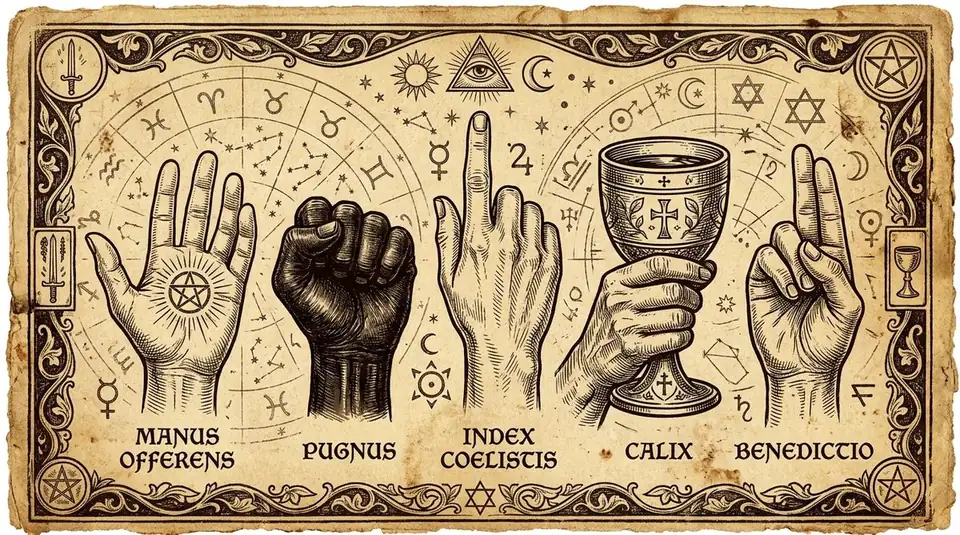
People lie with their faces all day long; they rarely remember to lie with their knuckles. That is true in a drawing room and doubly true on pasteboard. When a reader glances at the Four of Pentacles and mutters "financial conservatism," they are sanitizing a hilarious piece of physical comedy: a man sitting on a crate outside town, clamping a massive gold disk against his ribs with both wrists while pinning two more under his soles and balancing a fourth on his crown like a circus seal. Studying hands in tarot cards strips away the polite abstract nouns and shows you what the will is actually gripping, shoving, or dropping on the floor.
Forget the keywords for five minutes and watch the fingers. In The Tarot Codex, a card is a stage play before it is a philosophy lecture. (If you want the wider grammar of why pictures outrank word-lists, see why tarot is a symbolic language).
Seven Things a Painted Hand Can Do
When we catalogued the body language in tarot for Codex VIII: The Body Language of Tarot, we broke the manual chironomy of the deck into seven distinct postures. Each one betrays how the figure handles power.
Open Palms: The Unclenched Conduit
Looking at open hands in tarot means watching someone who has stopped hoarding. Take The Star (XVII): she kneels naked by the bank, tilting two red ewers without a trace of white-knuckled strain, letting the water spill straight onto the dirt and the pond. Nothing sticks to her fingers. When open palms show up alongside clear sightlines (see our notes on how to read gaze direction in tarot cards), the querent is being told to uncurl their fingers and let the current pass through.
The Fist and the Clamp
Now look at closed hands in tarot. The Latin rhetoricians called the fist pugnus, in contrast to the open palm of demonstration; in the cards, a clamped hand is a locked vault. Our miser in the Four of Pentacles has turned his forearms into a padlocked strongbox over his heart. He isn't enjoying his money; he is serving a life sentence as its security guard.
How the Tool is Held
Two people can hold the exact same suit emblem with completely opposite nervous systems. The Queen of Pentacles cradles her coin in her lap with two soft, curved palms as though checking the weight of a ripe melon. The Knight of Swords wraps a single iron gauntlet around his hilt and slashes the air above his horse's ears. One is husbandry; the other is assault.
The Outstretched Offer
Every Ace in the Rider-Waite deck consists of a giant disembodied cuff poking out of a grey cloud, holding a tool flat on an open or lightly curled palm (manus offerens). In the Six of Cups, a child in a red hood uses both hands to pass a flower-stuffed goblet to a smaller girl. The diagnostic trick with an offering hand is checking the card next door: is anyone over there actually reaching out to take the thing, or is the gift being held out to an empty corridor?
The Index Finger of Command
In The Magician (I), the right hand hoists a double-ended wand toward the top margin while the left index finger jabs straight down at the roses and lilies in the dirt. That old Hermetic stage-gesture organizes the entire vertical axis of the card. Pointing fingers boss the reader's eye around the table; they say "look here, stupid" when the querent is busy staring at the wallpaper.
Crossed Wrists and Sleeved Secrets
When the blindfolded woman in the Two of Swords crosses her forearms over her collarbones, she is turning her own ulna and radius into a portcullis. You cannot reach her heart without losing a finger on her blades. Sleeved or behind-the-back hands do the same work more quietly: agency is being withheld from the room.
Dropping the Hardware
Look at the two losers trudging toward the water in the background of the Five of Swords. Their blades are lying on the turf; one fellow has his palm clapped over his weeping face while his other arm hangs dead at his hip. Dropping the tool ends the scene, either because you have been beaten flat or because you finally had the sense to stop swinging.
Skin Against Element
A hand never exists in a vacuum when there is props on stage. As we hammer home in Codex V: See the Card Clearly, what figures hold in tarot alters the tendon tension of the wrist. You cannot hold a broadsword the way you hold a wineglass unless you want four severed fingers in your lap.
Steel demands a dry, deliberate grip on the pommel; grab a sword by the blade and you are reading self-harm, not strategy. A chalice requires a cupped palm underneath the base or a light pinch on the stem, because squeezing a full goblet only sloshes wine over your cuffs. Wands are living wood - note the little green shoots sprouting from the staves - so the hand grips them vertically like a walking stick or a torch. And Pentacles are dead weight. You balance them like the juggler in the Two of Pentacles, or you stack them on a workbench. Always check where the flesh meets the prop: the Devil doesn't even have human fingers left on his feet, just bird-talons gripping his black cube, which tells you everything you need to know about how addiction holds onto its perch.
Hands Across the Three Ranks
Major Arcana: Cosmic Chiropractic
In the trumps, manual gestures become constitutional law. The Emperor keeps his hands miles apart, left fist on the golden orb, right fist clamping the Crux Ansata scepter, each arm bolted to an armrest like a stone gargoyle. Then look at Strength (VIII): a woman in a white shift gently closes the jaws of a red lion with bare, unarmored fingers, using the touch you would use to check if a loaf of bread is warm. And poor Hanged Man (XII) has both wrists tied behind his lumbar spine while hanging upside down from a living T-cross. He couldn't scratch his own nose if a wasp landed on it; his entire reading is about what happens when your hands are taken out of commission.
Court Cards: Four Stages of Grip
Watch the Wands court to see how a person learns to handle fire. The Page of Wands plants his staff on the desert sand and holds it with both hands at eye level, staring at the top sprouts like a boy who just found a strange lizard. The Knight of Wands yanks the club into one fist while his horse rears in mid-air. The Queen of Wands opens her arms wide across her throne - wand in the right, sunflower in the left - inviting the whole room in without dropping her stick. And the King of Wands rests his knuckles on his knee while holding the staff like a surveyor's rod. Amateur to master, entirely in the wrists.
Pips: Calluses and Bruises
Down in the numbered pips, hands get dirty. The stonemason in the Eight of Pentacles has a mallet in his right fist and a chisel in his left, cutting the same five-pointed star for the sixth time that morning. Compare his steady workshop grip with the paranoid veteran in the Nine of Wands, whose bandaged head twitches sideways while both hands white-knuckle a single stave like a man waiting for the floorboards to give way.
Auditing the Knuckles in a Spread
We give the full visual protocol in Codex I: Tarot by Sight (which goes out free to newsletter subscribers). When you lay out the spread, count the visible hands before you read the positions. Notice who is hiding a hand behind a cloak or off the edge of the card, because a one-handed offer usually has a dagger or an invoice tucked behind the back. Check the knuckle-whiteness: is the figure cradling their suit symbol or strangling it? Then follow the vector from a pointing index finger or an outstretched goblet straight across the border into the adjacent card to see whether the neighbor catches the pass or lets it hit the floor.
Frequently Asked Questions
What if a figure's hands are completely hidden under a cloak, like the Hermit?
Actually, the Hermit's hands aren't hidden at all: his right hand holds the six-pointed lantern at eye level and his left grips the grey staff. For genuinely hidden hands, look at the cloaked mourners in the Five of Cups or the passengers huddled in the Six of Swords. When hands disappear inside woollen folds, the person has pulled their arms inside the shell; they are refusing to touch or manipulate the external world until the shock wears off.
What does it mean when a hand appears from a cloud, as in the Aces?
Art historians call it the Manus Dei, the Hand of God poking through the ceiling of the theatre. In a reading, it means raw material has been dropped onto the querent's desk free of charge, though a hand in a cloud will not build the house for you; somebody still has to take the tool out of its palm.
Does the left hand mean something different than the right hand in tarot?
In old European emblematics, the right hand (dexter) dispatches and commands while the left (sinister) receives or withholds. Pamela Colman Smith was wonderfully inconsistent about it when she reversed drawings for the lithographic stone, so look closely: when the Queen of Swords raises her left palm while gripping the sword in her right, the invitation is guarded by the blade.
What if a card has no figures or hands visible?
Cards like the Eight of Wands or the Three of Swords are pure ballistic trajectory - sticks flying through the air or blades already driven to the hilt. Look to the cards on either side to see whose hand threw them or whose hands are raised to block the landing.
Continue the Method
Manual chironomy and visual card mechanics are treated in these volumes of The Tarot Codex:


