
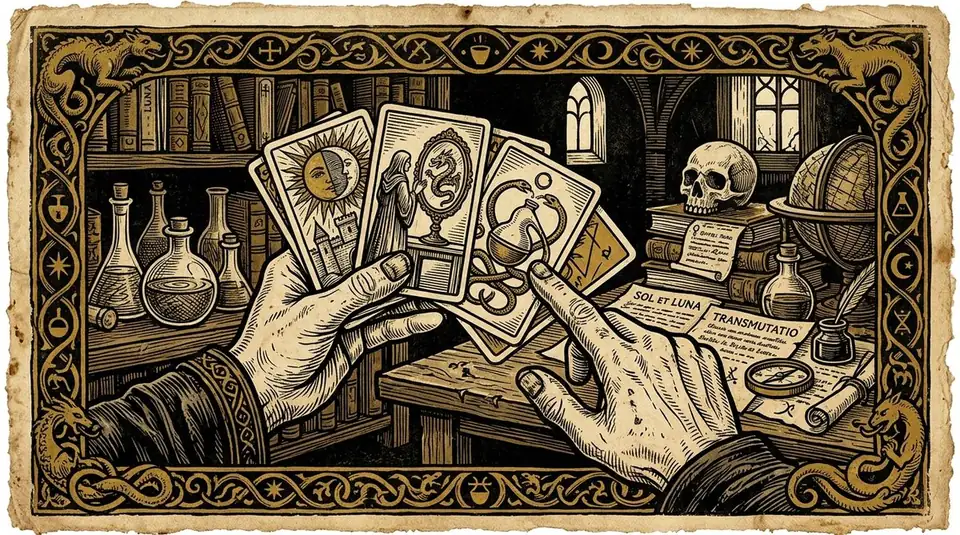
Most people ruin their eye for tarot during their first week with a deck. They buy a box of seventy-eight cards and fish out the tiny fold-out leaflet Waite or some anonymous copywriter tucked inside, trying to cram seventy-eight separate grocery lists of keywords into their skull. Then they lay three cards on a table. What they get is three stubborn, isolated dictionary entries that refuse to speak to one another, leaving the reader to stitch together dead slogans with awkward conjunctions while the client stares at the tablecloth.
In The Tarot Codex, we start from a blunt premise: tarot is a visual syntax, an optical grammar with its own strict case endings and declensions. Every language requires a lexicon of suits and recurring heraldic emblems alongside a syntax of postural tension and spatial proximity across the cloth. Once you grasp the rules governing how painted signs lean on each other, rote memorization becomes redundant. You read the pasteboards the way a compositor reads lead type.
The Bankruptcy of Flashcard Cartomancy
Keyword-mongering fails because it amputates the image. Take the Three of Swords. Memorize it as "heartbreak and weeping" and you go blind to what Pamela Colman Smith actually drew in 1909: a plump red heart suspended in mid-air against heavy theatrical storm clouds, pierced at neat geometrical angles by three identical blades while not a single human body appears in the frame. That sorrow is strangely clinical and dry-eyed. Put it beside the Ace of Swords and it reads like a surgical incision; drop it beside the Four of Cups and it turns into a stale grudge nursed in a bedroom.
Words sit still on a page. Pictures pick fights with their neighbors. A slight tilt of a heavy gold crown or the direction a horse's muzzle points will immediately sharpen or sour the neighboring card's meaning, just as a stone garden gate changes the whole story depending on whether it is latched or swinging wide. Treating seventy-eight theatrical stage sets like vocabulary flashcards throws away ninety percent of the ink you paid for.
The Four Structural Pillars of the Deck
Reading the pack as a coherent tongue requires tracking four distinct layers at once.
Archetypes and the Existential Threshold
The twenty-two Trumps of the Major Arcana deal in big, heavy-footed human predicaments: the arrogance of youth, institutional authority, public ruin, moral surrender. They act as the root verbs of a spread. When a Major card hits the table, it sets the barometric pressure of the entire consultation and tells you what kind of structural upheaval is underway.
The Elemental Suits
The Minor Arcana carves daily life into four elemental provinces: Fire in the Wands for ambition and friction, Water in the Cups for affection and soggy nostalgia, Air in the Swords for sharp-edged calculation, plus Earth in the Pentacles for coin and bone. The suit supplies the noun phrase. It tells you whether the drama is happening in the bank account or the liver.
Numerical Progression
Running from the Ace down to the Ten, the pip numbers trace a predictable rise and decay. A Five is a rupture in the container, whether that shows up as two beggars limping past a stained-glass window in the Five of Pentacles or a petty victor's smirk on a windy battlefield in the Five of Swords. The digit tells you how far along the rot or the harvest has progressed.
Optical Particulars
Inside the border sit the small, stubborn facts of the drawing: which hand holds the implement and how high the horizon line sits, or whether the figure turns their shoulder toward the card on their left. These visual minutiae, which lazy readers brush past on their way to a memorized slogan, rescues a reading from generic fortune-cookie mush.
How Three Cards Build a Clause
Laying multiple cards down is an exercise in sentence construction. Take a plain three-card line consisting of the Two of Wands beside the Knight of Swords, with the Ten of Pentacles on the right.
A reader raised on little white booklets will mutter something about planning and decisions followed by hasty action that ends in family wealth. It sounds like a badly translated horoscope. Look at the drawings instead. In the Two of Wands, a burgher stands on a high stone battlement clutching a tiny globe, staring out toward the right margin; right on cue, the Knight of Swords bursts into that exact space at a flat gallop with his blade leveled into the wind, driving all that quiet rooftop calculation straight through the stone archway of the Ten of Pentacles where the old man and the dogs sit under the family escutcheons. One continuous motion runs across all three frames. The gaze in the first card launches the horse in the second, and the horse crashes into the courtyard of the third.
Looking Before You Talk
The core discipline in Codex I, Tarot by Sight (which goes out free to newsletter subscribers), is keeping your mouth shut for five seconds after the card turns over. Refuse the urge to rummage through your memory for a textbook definition. Interrogate the drawing instead.
Start with the spine and legs: is the person slumped on a bench or bracing their boots against a slope? Check the weather in the background, because a flat yellow sky carries a completely different nervous charge than pitching slate-gray waves or the dead black vacuum behind the Swords. Then look at where the physical gravity settles, noticing what the hands are clutching too tightly and what has been dropped in the dirt.
Once your eye registers what is actually printed on the cardboard, you do not have to remember a thing.
The fastest way to break a bad keyword habit is to strip away the spread entirely. Pull a single card for a yes or no question and force yourself to name the posture and the weather before you utter a verdict. If you cannot see the rain in the background, you have no business predicting the storm. For a step-by-step introduction to deck structure, question phrasing, and a fully worked three-card reading, continue to our complete beginner's guide to tarot.