
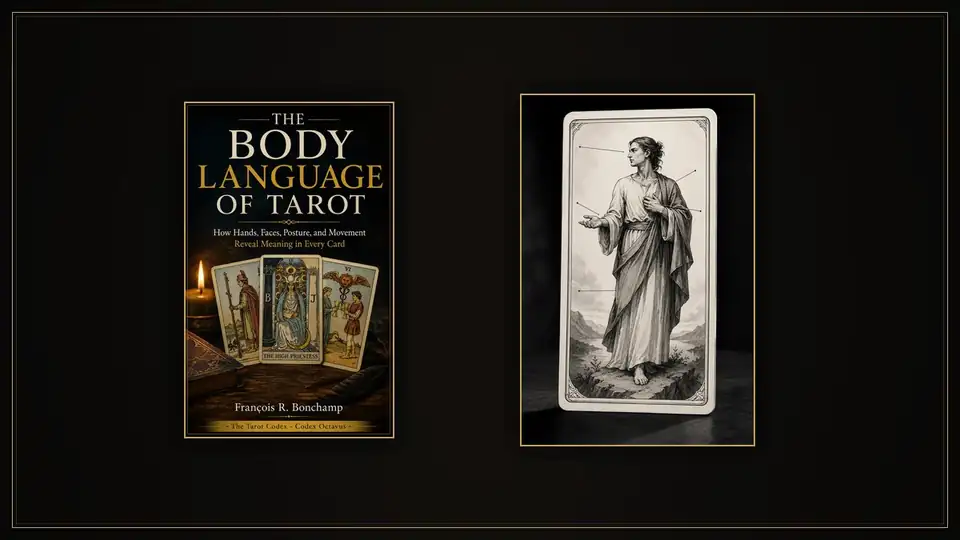
Long before anyone scratched cuneiform wedges into wet river clay, human primates kept themselves alive by reading the angle of a stranger's collarbone in under half a second. Your autonomic nervous system still knows that trade by heart. In cartomancy, this biological literacy is worth ten shelves of occult dictionaries, particularly when you are working with a deck illustrated by Pamela Colman Smith, who spent years touring with Henry Irving and Ellen Terry at the Lyceum Theatre and drew every tarot card like a blocking diagram for a stage play.
In Codex VIII of The Tarot Codex, The Body Language of Tarot, we treat the little inked men and women on the pasteboards as anatomical bodies under physical load. Paper figures cannot fake their posture. If you copy the exact spinal curve of a card in your own chair, your ribs and diaphragm will tell you what the scene is about before your brain remembers the card's title.
Three Ways to Carry Weight
Every human figure in the deck is either sitting on a seat or standing on their boots, unless they have dropped down onto the floor.
The Seated Figure
When someone sits on a stone block or a wooden bench, their boots are out of commission. They have planted their backside on a piece of real estate and refuse to budge. How they hold their ribs on that seat tells the whole story.
Compare the open-chested calm of Justice or the King of Cups, where the spine rises straight out of the pelvis and the elbows rest easily on the stone arms, with the cramped crouch of the Four of Pentacles, where the man hunches his shoulders up around his ears while locking his ankles together and hugging a gold disk to his solar plexus like a dog guarding a mutton bone. Then look at the collapsed version in the Nine of Swords: the woman sits bolt upright in bed, yet her face is buried so deep into both palms that her neck practically snaps forward under the weight of her own midnight thoughts.
The Standing Figure
A standing body has kinetic options. It can swing a stick or walk straight out of the frame.
In the Magician or Temperance, the weight is split evenly between both legs, creating an easy plumb-line equilibrium that lets the hands work without straining the lower back; Temperance even dips one foot into the chilly stream while keeping the other dry on the bank. Shift that weight onto the back heel and angle the ribcage forty-five degrees away from the viewer, as in the Seven of Wands or the bandaged veteran of the Nine of Wands, and you get the classic pugilist's defensive crouch: the man has been hit once already and is using his wooden staff like a crossbar to keep the world off his chest. Lean the breastbone ahead of the front toe, as in the Page of Swords or the Knight of Wands, and the body is already falling forward into a fight before the feet have found level ground.
Knees in the Dirt
Dropping the pelvis below the knees surrenders the vertical monopoly of adulthood. Sometimes that drop is deliberate and unhurried, like the naked woman in the Star who rests one knee on the grass and places one foot flat on the surface of the pool while pouring from her red jugs. And sometimes the body hits the dirt because its knees have been chopped out from under it: the fellow lying face down on the shingle in the Ten of Swords, pinned like an entomologist's beetle by ten long blades, has zero muscular tension left because you cannot fall off the floor.
What the Elbows and Fingers Are Up To
We wrote an entire separate essay on what hands mean in tarot cards, because the fingers are where a liar gives the game away. An open palm turned toward the ceiling, or the loose two-fingered grip of the Fool holding his white rose as if it weighed nothing at all, tells you the nervous system feels safe in the room. White-knuckled fists clamped around wand shafts or chair handles betray an old animal terror of losing control. Pointing index fingers lecture the sky or the neighbors, whereas arms crossed tight over the breastbone, as in the blindfolded Two of Swords or the smug merchant of the Nine of Cups, build a bony fence across the heart and dare anyone to knock.
The Angle of the Chin
Follow the line of the cervical spine. A chin tilted up toward the top border, like the Fool staring at the empty yellow corner of the card while his boot hangs over an abyss, signals someone drunk on oxygen who has forgotten that stones are hard. A chin tucked down into the collarbone belongs to the mourner in the Five of Cups or the apprentice squinting at his chisel in the Eight of Pentacles; their whole world has shrunk to the three square feet in front of their shoes. Best of all is the twisted neck of the Five of Swords, where the winner holds three blades and smirks back over his own shoulder at the two beaten men walking toward the water. That sideways glance is the anatomical signature of a cheat checking to see if the police are coming.
Try It on Your Own Spine
Next time you draw a card that leaves your tongue tied, shove your chair two feet back from the table and mimic the drawing with your own meat and bones. Lock your knees the way the figure locks theirs, then cock your chin at the exact same angle and try to breathe for thirty seconds. Try sitting like the Four of Pentacles for half a minute and notice how quickly your jaw clenches and your breath gets shallow. Your muscles know what that posture costs.