
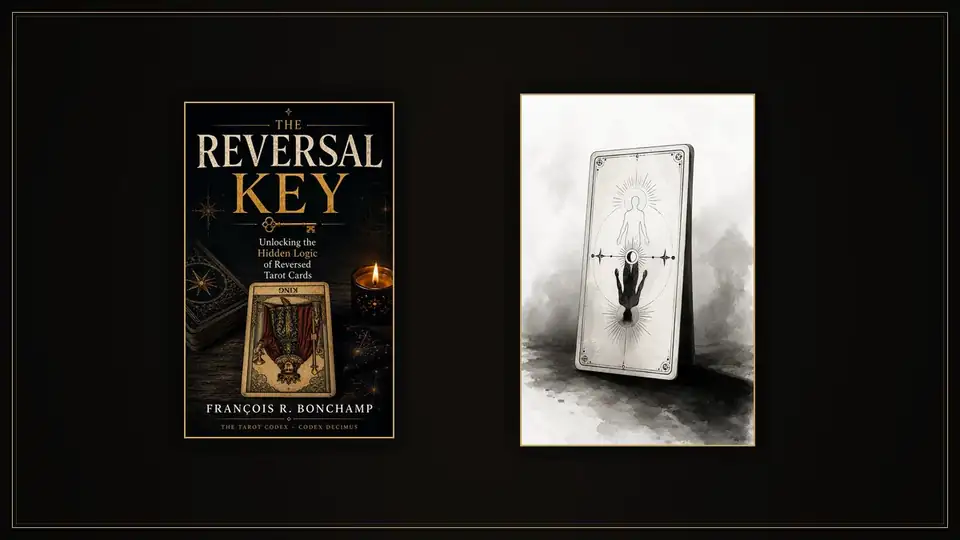
Nothing makes an intermediate tarot student sweat quite like an upside-down card. Half the Sunday-afternoon readers solve the problem by quietly twisting every inverted pasteboard right-side up before the client notices, muttering some pious excuse about how "the universe does not do negatives." The other half follows Etteilla's eighteenth-century habit of memorizing seventy-eight catastrophic antonyms: if upright means a wedding, upside-down means a funeral; if upright means a fat purse, reversed means the bailiff is at the door. Both camps are dead wrong.
In Codex X of The Tarot Codex, The Reversal Key, we treat an inverted card as a vector problem rather than a moral condemnation. Turning a piece of cardboard 180 degrees does not swap the picture out for its opposite. The root subject on the stock stays nailed to the table; what shifts is the plumbing or the pressure gauge inside the house where the noise is coming from.
The Field Never Changes
Look at the Empress. Upright, she lounges in her cushions surrounded by ripening wheat and cypress trees, presiding over somatic luxury and maternal fatness. Flip her on her head and she does not turn into the Tower. You are still standing smack in the middle of the Empress's territory. The inversion simply tells you that the plumbing in the greenhouse is backed up.
Maybe the sitter is smothering a grown child to death with unsolicited soup. Maybe they have spent six months pouring creative juice into someone else's business while their own garden goes to weeds. The noun remains Empress; the reversal supplies the crooked syntax.
Five Ways an Inverted Card Bends the Current
Instead of cramming seventy-eight bleak dictionary definitions into your head, test an inverted card against five mechanical adjustments.
The Current Turns Inward
An upright card usually happens out in the street where the neighbors can see it; turn it upside down and the whole play moves behind the eyeballs. An upright Hermit packs a canvas bag and buys a train ticket to the mountains, refusing to answer his mail. Flip the Hermit reversed, and the man is sitting in a crowded commuter train at five o'clock, completely alone inside his own skull while twenty people bump against his elbows.
A Stone in the Pipe
Here the archetypal horsepower is revving away, yet a jammed brake shoe keeps the wheels from turning. Upright, the Chariot rolls down the highway through sheer willpower. Reversed, the axles are up to the hubs in wet clay: the driver is whipping the sphinxes twice as hard and covering zero ground.
The Valve Blows Off
Sometimes an inversion shows a virtue pumped up until it curdles into a grotesque caricature. Upright Strength is the woman in white robes gently closing a red lion's jaws with two fingers. Turn Strength upside down and the touch goes clumsy: either the sitter is beating the beast over the skull with a stick out of sheer panic, or the lion has them pinned behind the sofa.
The Early Thaw
When a bright card turns up inverted at the end of a long run of Swords, it often points to the very first crack in the ice before the neighbors notice spring has arrived. An upright Sun is noon in July. A reversed Sun is 5:30 in the morning behind a bank of wet fog: the frost is still on the cabbages, though the light is undeniably coming up.
Refusing to Leave the Party
On the dark cards, an inversion routinely catches the sitter digging their heels into the doorframe to avoid an overdue exit. Upright Death is the clean, unsentimental sweep of the scythe. Reversed Death is the grim spectacle of someone keeping a dead marriage on mechanical ventilation for three extra years because they are terrified of the quiet that follows the funeral.
Counting Upside-Down Pasteboards in a Deal
Before you fret over why the Six of Cups is standing on its head, count the total ratio of inverted cards across the cloth. When every single card lands upright, the affair is playing out in broad daylight with all the furniture above ground. When four cards sit upright and a single card lands inverted, that lone upside-down pasteboard is the jammed gear tooth holding up the whole factory. And if seven or eight cards out of ten turn up reversed, the sitter has no business launching a public campaign this month, because the entire drama is locked in the cellar while they sort out their own private housekeeping.
You can watch this exact directional switch click in real time on a single draw. Go over to our free yes/no tarot reading and toggle reversals on: turn a brisk forward card upside down and the engine gives you Not Yet rather than a flat refusal, whereas turning a heavy barricade card like the Four of Swords upside down flips the answer to Yes because the coffin lid is finally coming unlatched. To see how overdriven virtues and toxic dosage play out positionally across upright and reversed plates, inspect our dossier on Paracelsus, Sola dosis facit venenum, and the 4-card dosage diagnostic inside The Paracelsus Spread. (If you are still in your first month with a deck, our complete beginner's guide to learning tarot explains why reading upright first spares you months of confusion.)