
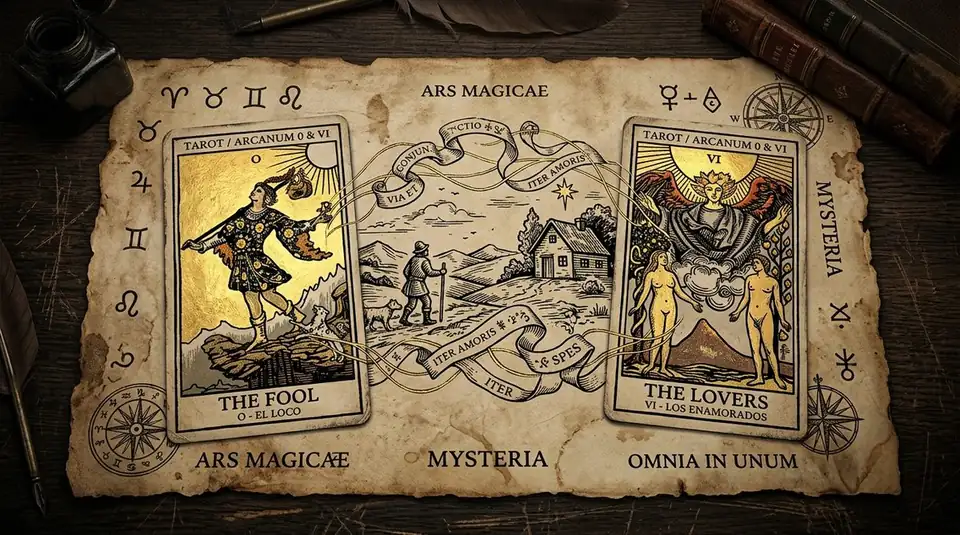
Any bright twelve-year-old can memorize seventy-eight single-card definitions over a rainy weekend. The real test of a cartomancer happens the second two or three pasteboards hit the felt side by side. Watch an amateur handle a three-card layout: they point to the left card and recite a keyword, then drop the word "and" like a wet brick before pointing to the middle card for a second slogan and finishing with a third disconnected noun on the right. The poor client walks out onto the pavement wondering how on earth they are supposed to experience "a new beginning, AND bitter grief, AND a fat inheritance" before Friday afternoon.
In Codex VII of The Tarot Codex, The Tarot Combination Method, we treat a spread as a single inflected clause. When two cards sit elbow-to-elbow on the baize, they infect each other. One card acts as the heavy substantive noun while its neighbor behaves like a spiteful adjective or an accelerating verb, bending the speed and temperature of the whole line.
Four Ways Neighboring Cards Interact
Doubling Down
When two adjacent cards share a suit or echo the same number in the same humoral ditch, they turn the volume knob up to ten. Lay the Three of Swords beside the Five of Cups and you have Air and Water conspiring in the same funeral parlor: the sharp mental realization of betrayal in the Three pours straight into the three spilled goblets of the Five. There is no silver lining to hunt for in that pair. Or put the Ace of Wands next to the Magician: raw unspent voltage drops directly into the hands of a skilled electrician who has all four tools laid out on his workbench.
The Noun and the Modifier
Most of the time, the heavier card in the pair establishes the room while the lighter card describes the weather inside it. Drop the Knight of Swords beside the Empress. Left to herself, the Empress wants to lounge on her pillows for nine months waiting for the barley to ripen. Bring the Knight of Swords charging into her parlor with his blade drawn, and that slow creative pregnancy gets subjected to a ruthless editorial deadline. Flip the pair around and put the Four of Cups beside the Ten of Pentacles: the family castle is paid for and the dogs are fed, yet the heir sits slumped under a tree in the garden, utterly bored by his own grandfather's money.
Head-On Collisions
When two cards pull in opposite directions, beginners panic and assume they shuffled badly. A seasoned reader grins, because a contradiction on the table is an exact X-ray of a human stalemate. Look at the Chariot paired with the Four of Swords. One card is an armored war wagon trying to gallop down the highway; the other is a stone effigy lying flat on its back in a church crypt. That client's ego is whipping the horses at eighty miles an hour while their nervous system has already pulled the main breaker switch and gone to bed. You see a similar tug-of-war when the Devil sits next to the Star: one boot is still chained to the black pedestal in the cellar while the other foot is already kneeling by the clean spring water outside.
The Domino Line
Across three or more cards, you can watch a chain reaction knock one frame into the next. Take the classic sequence of the Tower, followed by the Star, ending in the Sun. First the lightning bolt blows the pretentious brass roof off the masonry and dumps the occupants into the ditch; once the rubble stops smoking, the naked woman in the Star kneels in the quiet dark to wash the soot off; by the third frame, the Sun comes up over a brick wall that only reaches waist-high because nobody needs a fortress anymore.
Boiling the Table Down to One Sentence
As we demonstrate at length in our guide on how to turn tarot cards into one sentence, you should never let a client stand up from the table until you have hammered the spread into a single grammatical statement. Find the heaviest card in the row first, since a Major trump or a King will always boss a pip card around. Next, trace the optical sightlines to see who is turning their back on whom. Then speak the clause out loud in plain street English, naming the subject and the friction before showing where the weight lands.
Before you try juggling three cards at once, make sure you are not faking it with one. Pull a single-card yes/no draw where there are no neighboring pasteboards to hide behind; if you cannot state what a lone Seven of Wands is doing in one clean sentence, adding two more cards will only multiply the muddle.