Listen to an untrained reader stumble through a three-card draw and you will hear the most expensive game of Mad Libs on earth. "Here we have the Three of Swords, which is heartbreak... and next to it is the Two of Pentacles, which is juggling... and over here is the Hermit, so, um, solitude." That is a grocery list, never a reading. Learning how to read tarot cards together means forcing those three pasteboard rectangles into a single grammatical sentence with a subject, a transitive verb, and a direct object.
If you cannot turn tarot spread into a sentence that a sensible twelve-year-old could parse at the breakfast table, you don't know what the cards are saying yet. You are just rattling off flashcards and hoping the client does the carpentry for you.
The Disease of Keyword-Stacking
Blame the little white booklets tucked inside commercial tuck-boxes. Those booklets hand you five nouns per card - "grief, sorrow, tears" - and zero verbs. When two cards land side by side, a noun-stacker piles the two heaps of nouns on the carpet and stares at them. In The Tarot Codex, cards modify each other the way an adverb mugs a verb or a preposition boxes in a noun. Figuring out how to combine tarot card meanings requires assigning syntactic jobs to the pictures on the cloth, a discipline we start building in our foundational piece on how to read card combinations.
Five Slots in a Working Sentence
We laid out the full grammar of this method in Codex VII: The Tarot Combination Method (available as Codex VII Kindle or Codex VII paperback; Amazon affiliate links). Every clean tarot interpretation sentence needs five bolted-together parts.
The Subject (Who Owns the Nominative Case)
Find the protagonist on the table. Usually it is a Court Card, a Major trump, or whichever card sits squarely in the "Present" slot looking greatest in weight. Before you name the Subject, look at the physical figure using the observation rules in Codex I: Tarot by Sight (which is free to newsletter subscribers). Who is actually standing on stage?
The Pressure (The Transitive Verb)
Something is squeezing or shoving that Subject. Swords slice or audit; Wands shove or scorch; low-numbered pips poke a stick into the spokes. This card supplies the active verb that knocks the Subject off balance.
The Vector (Adverbial Direction)
Check which way the Subject's nose and boots point. Are they sprinting toward the right margin or backing cautiously into the left? That gives your verb its speed and direction.
The Wall (The Prepositional Snag)
Locate the card where the movement jams up against a fence: a stone parapet, a blindfold, ten heavy sticks tied in a bundle, or an upside-down courtier refusing to budge. This is the "against" or "despite" clause of your sentence.
The Landing (The Terminal Clause)
Where does the dust settle when the sentence ends? The final position or the dominant element on the cloth tells you what the Subject has to do once they hit the wall.
Two Sentences Built on the Cloth
Two Cards: The Fool Meets the Ten of Wands
A graphic designer asks about quitting his agency job to start a solo studio and pulls The Fool on the left, the Ten of Wands on the right. A noun-stacker says: "New beginning, plus heavy burden." Useless. Look at the physical collision: the Fool in Position 1 is stepping blithely off his yellow cliff toward the right margin, and his front boot is about to land squarely on the bent spine of the labourer in the Ten of Wands, who is staggering along under a hay-wagon's worth of timber with his face buried in the sticks so he cannot even see the town ahead of him.
Put it in one breath: "An enthusiastic amateur leaps out of his day job expecting open air, only to land flat on his face under seventy hours a week of unglamorous bookkeeping and client deliveries." Notice how the Ten of Wands ceases to be a vague "stress" keyword and becomes the exact pavement the Fool hits when gravity turns back on.
Three Cards: Three of Cups, Queen of Swords, Ten of Wands
Three friends want to open a wine bar together. The cards fall: Three of Cups (left), Queen of Swords (center), Ten of Wands (right). Watch the Queen in the middle slot. She sits on her stone block in profile facing left, staring straight at the three dancing women hoisting their goblets in the Three of Cups, while her cold stone spine is turned completely against the poor pack-mule carrying the Ten of Wands on the right.
Build the sentence around her neck angle: "Because the three partners started this venture over drunken toasts, someone has to sit down with a sharp lawyer's pen and draw up a ruthless operating contract right now, before one gullible partner ends up carrying the entire bar on their back alone." The Queen of Swords is the grammatical hinge that saves the Three of Cups from turning into the Ten of Wands.
Inflecting the Verb
Suits Supply the Muscle
Never use a bland verb like "is" or "has" when a suit gives you a specific physical action. Wands burn, shove, hurry, and blister. Cups leak, soak, mourn, and forgive. Swords amputate, cross-examine, freeze, and divide. Pentacles weigh, mortgage, brick up, and outlast. Match the verb to the suit and half your work is done.
Pips Supply the Tense
An Ace is future-indicative or incipient ("begins to sprout"); a Five is an active collision in the present continuous ("is currently crashing through the floorboards"); a Nine or Ten is the perfect passive participle of a long habit that has already sent the bill ("having exhausted every last favour in the county").
Eyeballs Supply the Conjunctions
Two cards staring into each other's faces demand "confronts" or "negotiates with"; two cards standing back-to-back demand "while stubbornly ignoring." (If you haven't practiced reading neck angles yet, read how to read gaze direction in tarot cards).
Spread Slots Supply the Subordinate Clauses
Treat positional labels like "Past / Present / Future" as conjunctions rather than museum display cases. Position 1 starts with "Although you spent the last year...", Position 2 is your main clause, and Position 3 hooks on with "...which will force you to..."
Four Ways to Wreck a Sentence
First, stringing three clauses together with "...and also..." is just keyword-stacking wearing a false moustache; use subordinators like "because," "until," or "at the expense of." Second, forgetting what the client actually asked turns your sentence into fortune-cookie vapour - if a plumber asks whether his van's transmission will last till Christmas and you start waxing poetic about his inner child because the Page of Cups showed up, give him his money back. Third, stuffing nineteen adjectives into a run-on paragraph loses the thread before you hit the period. And fourth, stop trying to Frosting-coat ugly cards. When the Three of Swords and the Five of Pentacles land together, the sentence is supposed to taste like vinegar; putting a cheerful "growth opportunity" bow on the end is cowardice.
Frequently Asked Questions
What if a card has no figures? How do I find the Subject?
Make the weather or the room the Subject, or turn the pip card into an adverbial prepositional phrase: "Under the pouring rain of three vertical blades..." (Three of Swords) or "Across a table stacked with eight freshly hammered coins..." (Eight of Pentacles).
What if the cards in the spread contradict each other?
Good - human beings contradict themselves six times before lunch. Use the word "despite" or "while pretending not to." The Ten of Cups next to the Seven of Swords reads: "While the family poses for a sunny holiday portrait in the parlor, somebody is quietly sneaking out the back door with the silverware."
How do reversed cards fit into the sentence formula?
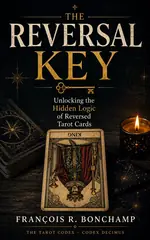
A reversal bends the verb inward, delays it, or jams the gear. Where an upright Knight of Wands "charges," a reversed Knight "stalls on the ramp" or "picks a fight with his own saddle." We work through the full mechanics of upside-down syntax in Codex X: The Reversal Key (available on Codex X Kindle and Codex X paperback; Amazon affiliate links), and in our shorter note on how reversed cards change meaning.
Can a sentence be too long or complex?
If you run out of breath before the period, chop it in two with a semicolon. We are writing clinical diagnoses, not mimicking Henry James after three ports.
Once your sentence has a spine, watch how the physical locomotion of the figures drives the plot forward in how movement creates story in a tarot spread, or test how four strict slots lock into a classical four-line stanza in our study on Nostradamus prophecies and writing Tarot quatrains alongside our interactive 4-Card Nostradamus Spread.
And if three cards still feel crowded, strip the drill down to a single rectangle: pull a one-card yes/no tarot reading and force yourself to state what the painted figure is physically doing with their hands and feet before you look at the printed answer. The gap between your sentence and your knee-jerk keyword is where you actually learn to read.
Continue the Method
Syntactic combination rules and visual reading protocols appear in these volumes of The Tarot Codex: