
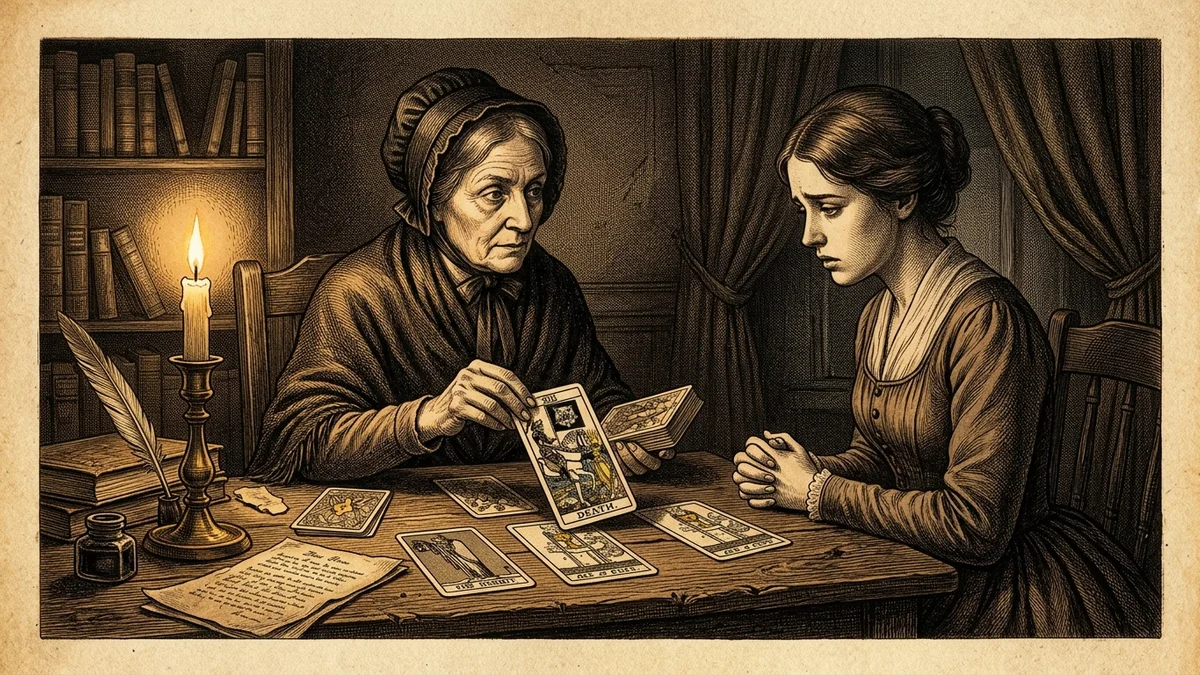
She never saw a single card she turned.
In the opening pages of my standalone treatise, Across the Table: Tarot, Charlatans, and the Gift of Reading People, we meet Madame Odile. For thirty years she laid cards for clients in a cramped room above a pharmacy in Lyon, and for the final twenty of those years she was stone blind. Her fingers knew the softened corners of the pasteboards by touch alone, though the ink on the stock had long ceased to matter to her work. What she actually read was the creature occupying the opposite chair: the sudden catch in the glottis, the dry rasp of wool as a shoulder blade pulled back, the half-second delay before a polite lie, the unvoiced grievance dragged up the stairwell into the room.
While The Tarot Codex spends ten volumes dissecting the visible emblems and postural mechanics inside the lithographed frame, Across the Table turns the lamp around to inspect the rest of the room. Somebody has to look at the human psychology and the subtle interpersonal fencing that takes place across the green baize.
Three Centuries of Reinvention and Parlor Smoke
Modern practitioners love to flatter themselves that tarot descended through antiquity as an unbroken chain of priestly initiation. The historical archive tells a much dirtier and far funnier story.
For its first three hundred years, from the gilt Visconti-Sforza courts of fifteenth-century Milan and Ferrara down to the noisy taverns of Marseilles, tarot had zero prophetic pretensions. It was Tarocchi, a trick-taking gambling game played for small coins and wine. Then came 1781. Antoine Court de Gebelin, a Swiss-French Protestant pastor with an appetite for grand unified theories, stared at a Tarot de Marseille pack in a Parisian drawing room for about fifteen minutes and declared it the sole surviving hieroglyphic book of the ancient Egyptian priesthood.
Once that glorious piece of scholarly hallucination took root, the cards mutated rapidly. Jean-Baptiste Alliette, a Paris seed-seller who reversed his surname into the grander-sounding "Etteilla", set up shop as the first professional occult cartomancer and assigned strict divinatory tags to upright and inverted cards while complaining bitterly about his rivals. A generation later, Marie Anne Lenormand read for Josephine Bonaparte and half the anxious oligarchs of Napoleonic Paris, lending her dead name to a thirty-six-card pack that had actually started life in 1799 as a Nuremberg coffee-house dice game called Das Spiel der Hoffnung. Later still, the Victorian bureaucrats of the Hermetic Order of the Golden Dawn locked the deck into a complex grid of Kabbalistic paths and decanates in chilly London backrooms, before Pamela Colman Smith painted her seventy-eight stage-lit scenes in 1909 for Arthur Edward Waite and what she tartly described as "very little cash". From those theatrical illustrations the line runs straight down to kitchen-table Kipper sessions, late-night 1-900 telephone boiler rooms, and the cold silicon churn of algorithmic tarot apps.
The Counterfeiters and the Cold Reading Machine
Wherever grief and romantic desperation congregate, predators set up a folding table. A substantial portion of Across the Table is devoted to a forensic dissection of fortune-telling fraud and the linguistic clockwork of cold reading.
From the English Witchcraft Act of 1735 (which prosecuted fortune-tellers for pretending they possessed occult powers rather than for consorting with demons) down to contemporary wire-fraud indictments, the swindler's playbook has barely needed an edit. Consider the classic curse-removal extortion, a sordid theater in three acts. First comes the diagnosis of a hidden affliction, wherein the operator convinces an exhausted client that their string of bad marriages or failed ventures stems from an inherited hex or malefic spiritual residue. Next follows the demarcation of isolation: the mark is sternly warned never to mention the work to spouses or friends, thereby severing every external reality check. Finally arrives the escalating financial purification, requiring bundles of cash or family jewelry to be handed over so they might be buried in churchyard soil or burned in secret vigils that, by sheer coincidence, leave the bank notes entirely unharmed in the swindler's pocket.
Even readers who would never dream of stealing a client's watch fall routinely into the softer traps of cold reading. Without an iron grasp of how these linguistic levers operate, well-meaning practitioners trick themselves every afternoon, mistaking a standard conversational feedback loop for a bolt of clairvoyance.
The machinery is embarrassingly simple once you strip the velvet drapes off it. There is the Barnum or Forer statement, an observation phrased to sound intimately diagnostic while fitting ninety percent of the walking population: telling someone they harbor vast reserves of unexpressed talent that their current circle fails to appreciate never misses. Pair that with the Rainbow Ruse, which credits the sitter with a personality trait and its exact inversion in the same breath, such as noting that they are ordinarily reserved and accommodating, yet turn formidable once pushed into a corner. And when those stall out, the lazy operator resorts to shot-gunning, tossing out a scatter of common initials or vague bodily complaints until the eager sitter volunteers the missing biographical link and credits the reader with a miracle.
A School of Attention
Strip away the pseudo-Egyptian incense and the parlor-trick syntax, and what remains of the craft is a fierce, disciplined school of observation. It owes far more to crisis negotiators and seasoned police interviewers than to theosophical salons.
Establishing the Baseline
In bad television dramas, a suspect folds their arms or rubs their nostril and the detective barks that they are lying. Behavioral science has no patience for such dime-store decoding. A single physical gesture means nothing in isolation. Plenty of people cross their arms because the radiator is broken, and others speak in a clipped whisper because a molar is abscessed.
Competent readers spend the first three minutes of a session establishing the client's baseline while pouring tea or shuffling the pasteboards. You watch their resting spinal alignment and the natural cadence of their breathing, noting where their gaze drifts when they answer a harmless logistical question. Only the departures from that personal baseline, the sudden somatic micro-tax that gets levied when a specific suit hits the wood, tell you where the nerve is exposed.
The Golden Second
In cartomancy there is a single fraction of time that outweighs twenty minutes of subsequent talk. It occurs at the exact instant a card is flipped face up on the cloth. Before the polite social mask can reassemble itself, the autonomic nervous system votes on the image. The pupils dilate a fraction of a millimeter or the breath catches high in the throat; the shoulders execute a tiny recoil away from the table edge, or the jawbone subtly unclenches as the throat muscles tighten. That involuntary flinch, which a hundred years of parlor occultism have tried to dress up as telepathy, tells you where the actual question lives before a syllable is spoken.
Tactical Empathy and Calibrated Silence
Novice readers chatter endlessly out of sheer stage fright, drowning the table in adjectives because five seconds of quiet feels like a professional failure. A veteran reader drops one precise, open-ended question onto the felt and then shuts up. Silence is the solvent. Give a defensive sitter enough unhurried quiet, and the story they prepared in the taxi on the way over dissolves on its own.
Inside the Frame and Across the Baize
The relationship between The Tarot Codex and Across the Table is a matter of focal length.
Inside the Card
Codex VIII: The Body Language of Tarot dissects the painted figures on the cardstock: the stiff neck of the Emperor, the veiled stillness of the High Priestess, the wide defensive stance in the Seven of Wands, the bowed head in the Five of Cups.
Across the Table
Across the Table reads the breathing anatomy on the other side of the wood: the vocal tremors and baseline shifts, alongside the protective fictions people build to survive their own choices.
The Synthesis
Joining strict iconographic literacy with psychological observation produces consultations that cut to the bone without ever asking the client to believe in ghosts.
A deck of cards is seventy-eight pieces of varnished paper. Until someone sits down opposite you with a secret they are half-afraid to hear out loud, the pasteboards have nothing to say.