
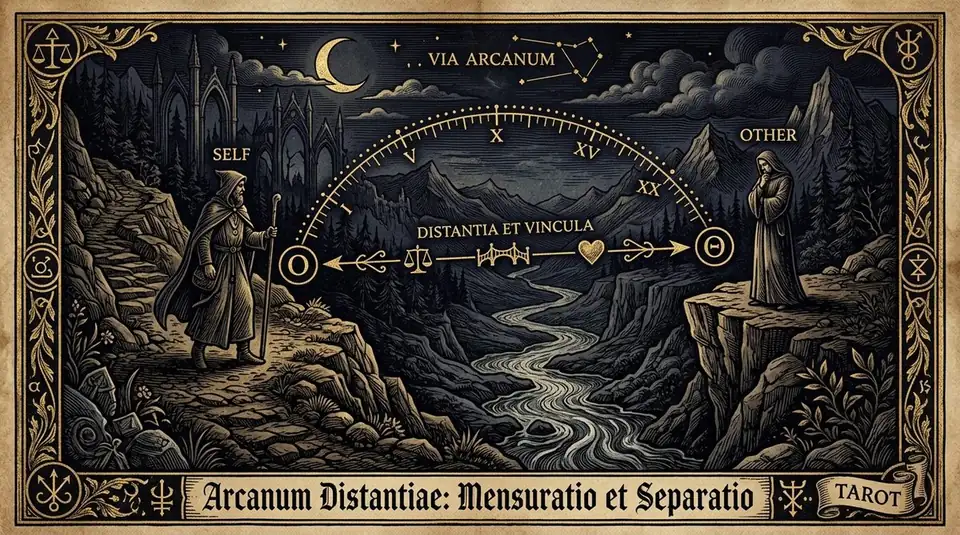
A stage director can tell you whether a marriage is dead before either actor speaks a line, simply by measuring how many feet of floorboards sit between their chairs when the curtain rises. Tarot works on the exact same geometry. Most readers get so hypnotized by the shiny emblems that they never measure the distance between figures in tarot scenes, treating a card where two people are practically breathing down each other's necks as identical to one where a quarter-mile of muddy beach separates the foreground from the back.
Bring a yardstick to the spread. Measuring the tarot figures distance meaning turns vague psychological guesswork into plain carpentry.
Proxemics on Pasteboard
Edward T. Hall coined the word "proxemics" in the 1960s to describe how animals and mayors use square footage to bully or seduce one another; Pamela Colman Smith had already drawn every inch of it into the 1909 Rider deck half a century earlier. The space between people in tarot cards is emotional insulation made visible. You always pair this measurement with eye vectors (if you skipped that step, go back and read how to read gaze direction in tarot cards). Two figures staring at each other from six inches apart are about to kiss or trade punches; two figures staring at each other across three intervening cards are shouting through a tin-can telephone. We mapped the full anatomy of these intervals in Codex VIII: The Body Language of Tarot (available as the Codex VIII Kindle edition or Codex VIII paperback; Amazon affiliate links).
Elbow-to-Elbow: When the Gap Closes
Look at the Two of Cups. The youth and the woman stand close enough that their outstretched goblets nearly clink, and his right hand is already lifting her left wrist. The tarot relationships visual distance has collapsed to zero because neither party is wearing a breastplate or hiding behind a desk. You see the same warm crowding in the Ten of Cups, where the parents have their arms wrapped around each other's waists while the two children dance two paces away.
Now look at what happens when close proximity turns rancid. In The Devil (XV), the naked man and woman stand just as close together as the pair in the Lovers, except their necks are bolted with loose iron chains to the same black masonry block below the goat-demon's claws. That is codependent suffocation: two people locked in the same cellar who cannot take three steps sideways without rattling the iron.
Acres of Cold Air
Stretch the space between characters and the temperature drops. In the Five of Pentacles, the woman in the ragged shawl and the man on crutches trudge through the same snowbank two feet apart, yet neither touches the other's sleeve or glances sideways. Hypothermia is a solitary business; they are sharing a blizzard, not a conversation.
Or measure the foreshortened beach in the Five of Swords. The grinning victor stands right up against the front margin cradling three blades, while his two beaten opponents are tiny figures twenty yards back toward the waterline. That depth-of-field gap is humiliation in perspective. And in the Eight of Cups, the other person isn't even in the county anymore - just eight empty brass goblets stacked on the sand while a lone back disappears into the gorge.
Who Sits Upstairs: The Vertical Yardstick
Horizontal inches measure intimacy; vertical inches measure who signs the checks. Whenever one figure's boots are level with another figure's eyebrows, somebody is pulling rank.
Watch the Hierophant (V) perched high on his stone dais while two tonsured acolytes kneel on the steps below with the tops of their skulls aimed at his knees. That is institutional altitude: information flows strictly downhill from the triple crown to the carpet. In the Six of Wands, the laurel-crowned rider sits high on his caparisoned horse while the foot-soldiers march alongside his stirrups, which looks wonderful until you realize a man on a horse cannot whisper to anyone without leaning out of the saddle and risking his neck. And in The Devil, the beast squats on a plinth above his captives like a gargoyle on a chimney. Whenever a client's card sits physically lower on the vertical axis than their boss's or partner's card, they are negotiating on their knees.
Fences, Rivers, and Hardware in the Middle
Even when two people stand three feet apart, a single piece of furniture between them changes the physics. In the Three of Pentacles, the young stonemason stands on a wooden bench inside the abbey while the monk and the architect stand on the flagstone floor consulting the vellum plans; they are close, yet the bench and the pillar keep the tradesman and the clients in their respective lanes.
In the Six of Swords, six upright blades are jammed into the bottom of the punt right between the viewer and the huddled woman, forming an iron picket fence across the hull. And in the Two of Swords, the woman uses her own crossed wrists and two yard-long steel blades to wall her chest off from the room while a stone seawall behind her bench cuts her off from the harbor water. For how these barriers behave when two whole cards lock eyes or turn away across the cloth, see when tarot cards face each other in a spread.
Measuring Across the Gutter
Once you lay three or five cards in a row, the cardboard borders act like window frames looking out onto a single long street. Suppose the Queen of Cups sits in Card 1 facing right, and the King of Cups sits in Card 4 facing left. They want to talk to each other. Unfortunately, Cards 2 and 3 sit wedged between their thrones like two parked lorries in an alley.
Whatever lands in those middle slots is the physical mileage the couple has to walk through before they can touch hands. If Card 2 is the Eight of Wands, the gap closes in twenty minutes by express telegram; if Card 2 is the Four of Swords and Card 3 is the Ten of Pentacles, they have to walk through a hospital rest-cure and an entire family real-estate trust just to say hello. We work out these multi-card bridges step by step in Codex VII: The Tarot Combination Method (available on Codex VII Kindle and in Codex VII paperback; Amazon affiliate links).
Solitude Versus Exile
Beginners see a person standing alone in a card and immediately reach for the tissues. Hold on. Look at the woman in the Nine of Pentacles: she has the whole walled vineyard to herself, a hooded falcon on her gloved fist, and snails on the garden path that she doesn't even bother to step on. There isn't another human being within half a mile, and she is having the best Tuesday of her life. That is sovereign elbow-room. Compare her with the sulking youth in the Four of Cups, who has wedged his spine against a tree trunk in an empty meadow and folded his arms to pout at three brass goblets on the turf. The Nine of Pentacles cleared her calendar; the Four of Cups locked himself in the bathroom.
Where the Yardstick Bites
In love readings, count how many cards sit between the two court figures representing the couple: adjacent cards facing each other mean they are sleeping in the same emotional bed tonight, whereas three cards of Pentacles and Swords wedged between them mean the lawyer, the mother-in-law, and the mortgage are sleeping in the middle of the mattress. To see how two vertical columns face or evade each other across a central relational bridge, run a deal on our interactive 7-Card Love & Relationship Bridge. In office spreads, check the altitude - if the querent is a Page standing on the dirt while the boss is an Emperor on a granite cube, walking in to demand an equal vote will get the Page thrown down the stairs. And when all the cards represent factions inside the client's own skull, wide gaps between figures show a person whose left hand literally doesn't know what their right hand signed yesterday.
Taking the Measurements at the Table
Run the tape measure before you start talking. Spot every person or animal in the layout. Check whether figures inside each card are crammed onto the same bench or scattered across fifty yards of perspective. Look up and down the vertical axis to see who holds the high ground and who is kneeling in the mud. Count the fences, rivers, and swords planted between people, and finally count how many whole cards separate the two figures who are trying to look at each other across the table.
Frequently Asked Questions
What if a spread has no figures? How do I read the distance?
Measure the spacing of the hardware. In the Three of Swords, three blades are jammed through the same six inches of muscle; in the Seven of Wands, six sticks are poking up from a ditch below while one stick fends them off. Crowded objects mean acute pressure; scattered objects mean a diffuse mess.
How does distance affect the timing of a reading?
Inches on the table equal weeks on the calendar. When the significator in Card 1 is staring straight into the outcome in Card 2, the thing is already on the porch; when three heavy Earth cards sit between the person and the goal, pack a lunch.
Can animal figures be used to map distance and intimacy?
Watch the woman in the Nine of Pentacles holding the falcon right on her wrist, or the woman in Strength with her nose six inches from the lion's mane. When the human and the beast touch, the person is on speaking terms with their own appetite; when the wolf is howling fifty yards down the road in the Moon, the instinct is wild and unhousebroken.
What does it mean when a figure looks out of the card at the reader?
It zeroes out the distance between the cardboard and your chair. A frontal stare like Justice or the Emperor skips the other cards on the cloth and collars the querent directly across the table.
Continue the Method
Spatial proxemics and multi-card combination syntax are covered in these two volumes of the Tarot Codex series:

