
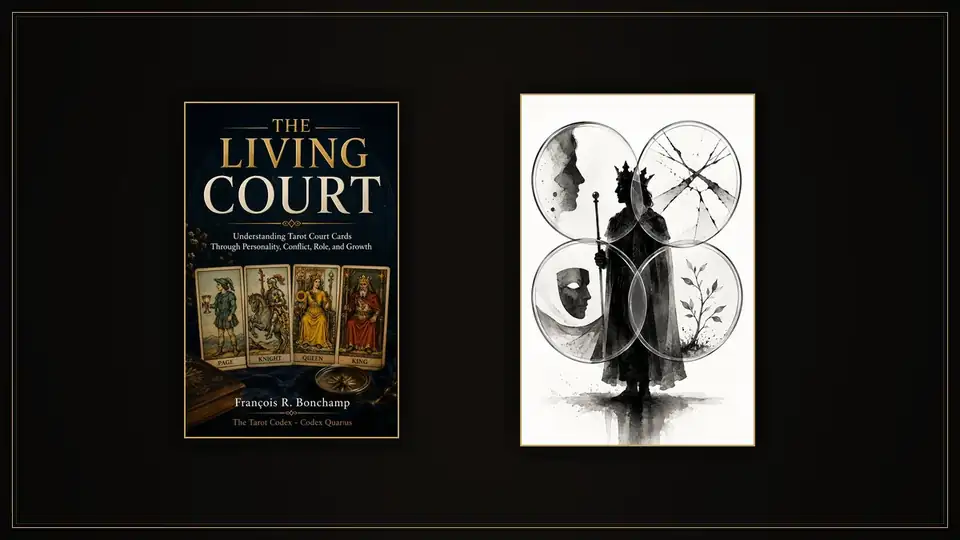
Corner a dozen practicing tarot readers after a glass of wine and ask which cards make them stall at the table. Eleven of them will confess it is the sixteen court cards. For the last hundred years, popular manuals have trained students to read the royal family like nineteenth-century phrenology charts or corporate Myers-Briggs badges: the Queen of Wands is always a chatty Aries redhead and the Knight of Pentacles is a stolid Taurus bookkeeper, while the Page of Cups is reduced to a dreamy boy with damp eyes. The moment a real client sits down with a real mess, those cardboard personality boxes collapse on the spot.
In Codex IV of The Tarot Codex, The Living Court, we throw the zodiacal wig-stand out the window. A court card is a behavioral posture, a specific feudal rank of human maturity operating inside an elemental province. Half the time, the figure on the pasteboard does not even point to a second person in the room. It points to an internal defense mechanism or a temporary uniform the querent has buttoned on to survive the week.
Feudal Rank as Psychological Altitude
To read the court without guessing, split the rank from the suit. The suit names the raw material (Fire, Water, Air, Earth); the rank tells you how much authority the person actually holds over that material.
Pages: The Apprentice on Foot
Pages stand on their own two boots. They have no horse and no throne, spending most of their time staring at the tool in their hands as if it just fell out of the sky: the Page of Cups chats with a fish poking its head out of a goblet, while the Page of Pentacles gazes up at a floating gold coin like a boy examining a strange beetle. A Page is a beginner. At their best, they bring an unspoiled curiosity and a willingness to try something without knowing the rules; when they sour, you get petty office gossip and the sulky refusal to sign their name to anything permanent.
Knights: The Monomaniac in the Saddle
Knights are the only court rank mounted on horseback, which means they are built for transit rather than governance. Where the Page pokes at the element with a stick, the Knight straps it to a lance and charges down the turnpike. They are specialists in excess. Send a Knight to take a hill and he will take it before lunch, though he lacks the Queen's patience to govern the village or the King's legal sense to draw up the treaty. In a clean mood, a Knight is pure forward propulsion and loyalty to the mission; off the rails, he is a fanatic who rides straight over his own infantry because he forgot how to pull the reins.
Queens: The Interior Cistern
Queens sit on heavy stone thrones, usually out in the open air where their robes blend straight into the turf or the surf. The Golden Dawn assigned them to Water of their respective elements, and for once the bureaucratic label fits the drawing. A Queen does not chase her suit across the county; she holds it inside her own ribs and lets it ferment. She rules by atmosphere and emotional gravity. When a Queen is upright and steady, she has more quiet authority in her little finger than the Knight has in his whole suit of armor; when she turns bitter, she becomes a master of the unspoken guilt trip, freezing the dining room with a single glance over her goblet.
Kings: The Municipal Magistrate
Kings sit under heavy draperies or out on fortified battlements, wearing crowns that look like they give them a headache by five o'clock. Their job is external architecture: laws, budgets, borders, public verdicts. The King of Swords does not care about your childhood excuses, and the King of Pentacles wants to see the ledger balanced in black ink before he pours the brandy. A sound King builds the stone wall that keeps everyone else dry; a rotten one turns into a tinpot household autocrat who confuses his own bad temper with the law of nature.
Four Ways to Pin a Court Card Down
When a royal face turns up on the cloth, stop trying to guess your client's uncle's hair color. Walk the card through four diagnostic doors and let the surrounding spread tell you which one stays open.
Sometimes the card really is an external actor walking around in the client's life, such as a micromanaging King of Swords department head or a generous Queen of Pentacles sister-in-law who keeps lending them rent money. Just as often, the card prescribes a strategic mask the situation demands: if you are walking into a hostile divorce mediation tomorrow morning, the spread may drop the King of Swords on the table to tell you to leave your damp handkerchief at home and read the contract clauses like a magistrate. In more private inquiries, the court figure exposes an internal psychological splinter, like the jittery Page of Swords who stalks an ex-lover's social media at two in the morning while pretending to be detached. And when a Page or a Knight lands at the edge of a layout, it frequently acts as sheer barometric tempo, announcing an incoming letter or a sudden Pickwickian row in a corridor.
Reading the Spine of the Horseman
As we lay out in Codex VIII, The Body Language of Tarot, the quickest way to tell the four Knights apart is to ignore their weapons and look at the horses' necks. In the Knight of Swords, Pamela Colman Smith drew the steed stretched flat out at a dead run against a gale, the rider's torso pitched so far over the pommel he is practically biting the horse's ears. Turn to the Knight of Pentacles and the beast is a heavy shire horse standing dead still on all four hooves in front of a newly plowed field, while the rider sits upright in the saddle inspecting a coin at eye level. One card is a bullet in flight; the other is a boulder with a visor.